Budget 10G Switch Battle: SODOLA 12-Port L2 vs SODOLA 8-Port L3 vs TRENDnet TL2-F7080
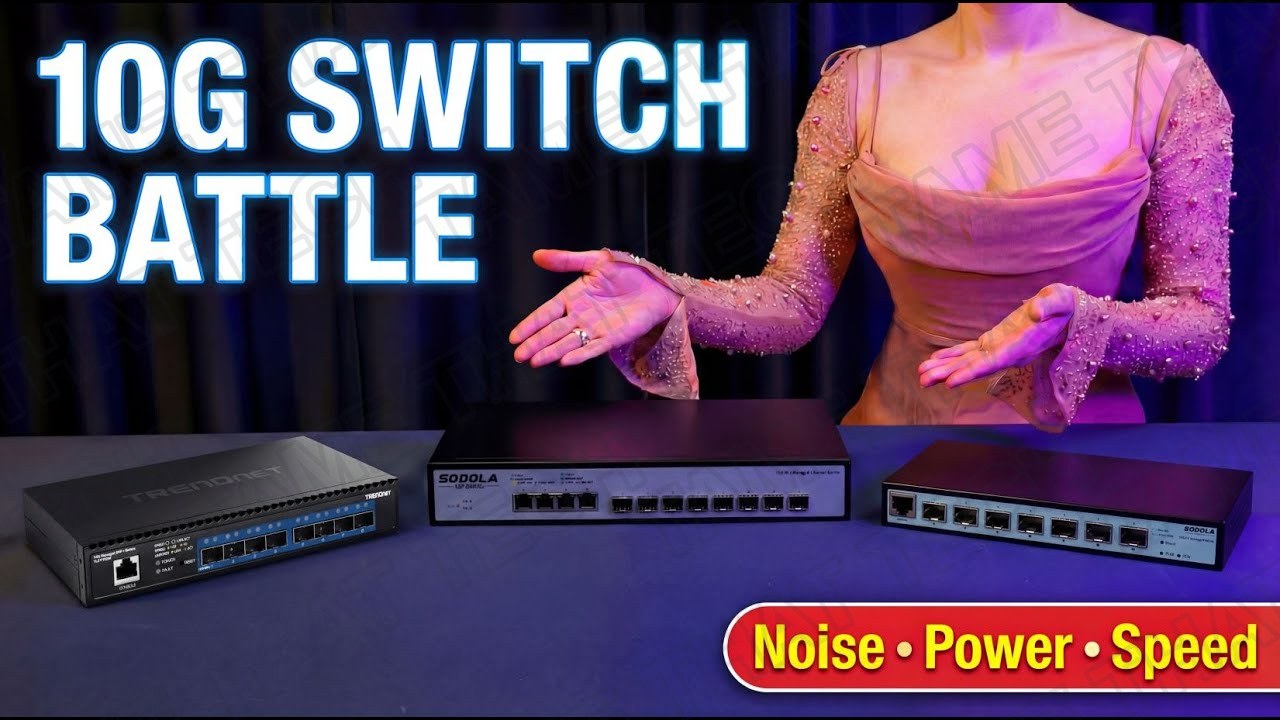
We’re putting three budget-friendly 10-gig switches head-to-head and finding out which one actually deserves a spot in your rack — or on your desk. On the bench: the SODOLA 12-port 10G hybrid, the fanless SODOLA 8-port 10G L3 switch, and the TRENDnet TL2-F7080 8-port 10G SFP+ switch.
We focused on the three things that matter most in a real homelab or small office: noise, power draw, and real-world transfer performance. By the end, you’ll know exactly which one fits your setup. (All three switches were bought/sourced — not sponsored.)
TL;DR — The 10-second verdict
| What it is | A three-way comparison of budget 10G switches: SODOLA 12-port hybrid (4× 10GBase-T + 8× SFP+), SODOLA 8-port fanless L3, and TRENDnet TL2-F7080 L2+ |
| Who it’s for | Homelabbers and small offices upgrading to 10G who care about noise, power, and real throughput — not just spec sheets |
| The headline | All three push line-rate 10G on real transfers; the choice comes down to port mix, silence, and routing features |
| The catch | SODOLA gear has thin docs and hit-or-miss firmware; the 12-port fan can whine; TRENDnet is SFP+ only and not silent |
| Our take | SODOLA 12-port = port density + copper; SODOLA 8-port L3 = silent routing core; TRENDnet = the safe business-grade pick |
| Where To Buy (Affiliate Links) | Amazon · Mavely · JoyLink |
| Video Review | YouTube |
The Contenders
1. SODOLA 12-Port 10G Managed Switch — SL-SWTGW2C48NS
The hybrid box: 4× 10GBase-T RJ45 + 8× 10G SFP+ ports. Web-managed L2 (VLANs, LACP, QoS, STP, IGMP snooping, basic security), rated 240 Gbps switching capacity / 178.56 Mpps, internal fan cooling, 1U rack-mount, external 12V/4A supply, ~45.8 W max board power. Aimed at people who want a mix of 10G copper and SFP+ on a budget — 10G NAS, workstations, plus fiber or DAC uplinks.
2. SODOLA 8-Port 10G L3 Managed Switch — SL-SWTGW3C8F
8× 10G SFP+ only, fanless, wall/desktop mount. Full L3 feature set: IPv4/IPv6 interfaces, static routes, RIP, OSPF, DHCP server/relay, ACLs, 802.1X, DHCP snooping, Dynamic ARP Inspection, IP Source Guard — a small enterprise feature set. This is the “make your switch the routing core” box.
3. TRENDnet TL2-F7080 — 8-Port 10G L2+ Managed SFP+
The traditional small-business option: 8× SFP+ (1G and 10G), L2+ managed (VLANs, LACP, MSTP, QoS, IGMP/MLD snooping, ACLs, 802.1X, IPv4/IPv6 static + inter-VLAN routing, DHCP relay), 160 Gbps / 119.04 Mpps, jumbo frames to 12 KB, smart temp-controlled fan rated to ~35 dBA, external 12V/2.5A, 23.5 W max. Established brand with proper docs, SNMP, and lifetime warranty in many regions.
On paper: SODOLA 12-port = port density & copper king · SODOLA 8-port = silent L3 lab brain · TRENDnet = safe business-grade L2+.
Test Setup & Methodology
Same environment for all three: a 10G-capable PC with NVMe SSD + PCIe 10G NIC, a 10G NAS/second PC for point-to-point tests, SFP+ DACs and SFP+-to-RJ45 modules where needed, CAT6a for 10GBase-T. Traffic via iperf3 plus large sequential file copies (50–100 GB) to catch real-world dips and stalls. Power was measured at the wall with a plug-in meter (idle no-links, idle one-link, full load). Noise was measured with a phone dB meter at one meter in a quiet room (baseline ~low 30s dBA).
Noise: Can You Live With It?
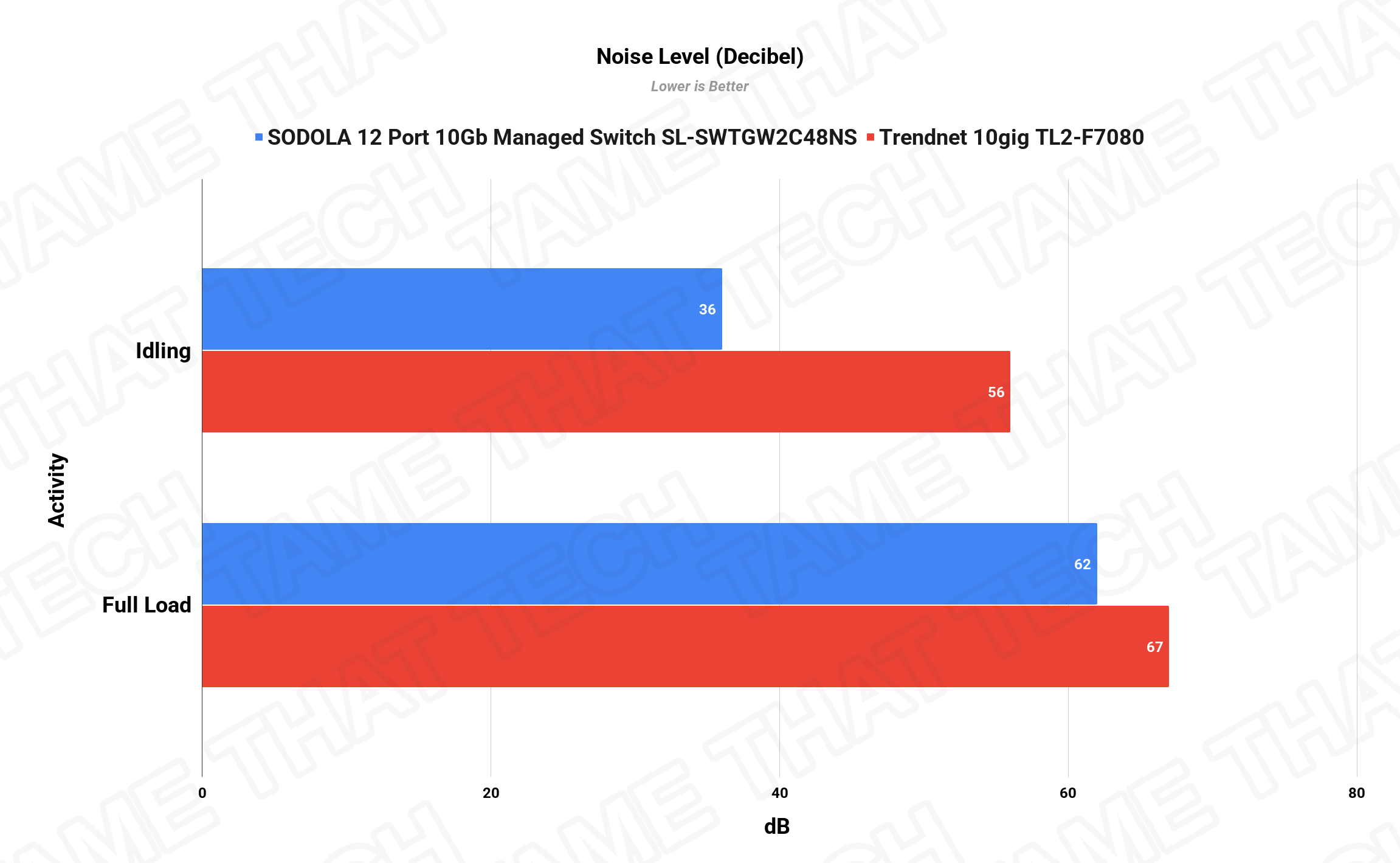
- SODOLA 12-port: the loud one. Fan spins up on power-up, constant whir at idle, ramps under load — “network closet” gear, not sit-next-to-your-monitor gear. The pitch is a bit high, and owners report the fan ramping up and down, which is more annoying than a constant hum.
- SODOLA 8-port L3: bliss. No fans at all — dead silent even with all SFP+ ports lit pushing traffic. For a homelab in your office or bedroom, this is a huge win.
- TRENDnet TL2-F7080: the middle. Single smart fan; audible low hum at idle, quieter and lower-pitched than the 12-port, ramps under load but never screaming. Acceptable in a small office or rack not in your bedroom.
If you need absolute silence, the SODOLA 8-port is the only one of these three that truly disappears acoustically.
Power Draw: 24/7 Cost to Run
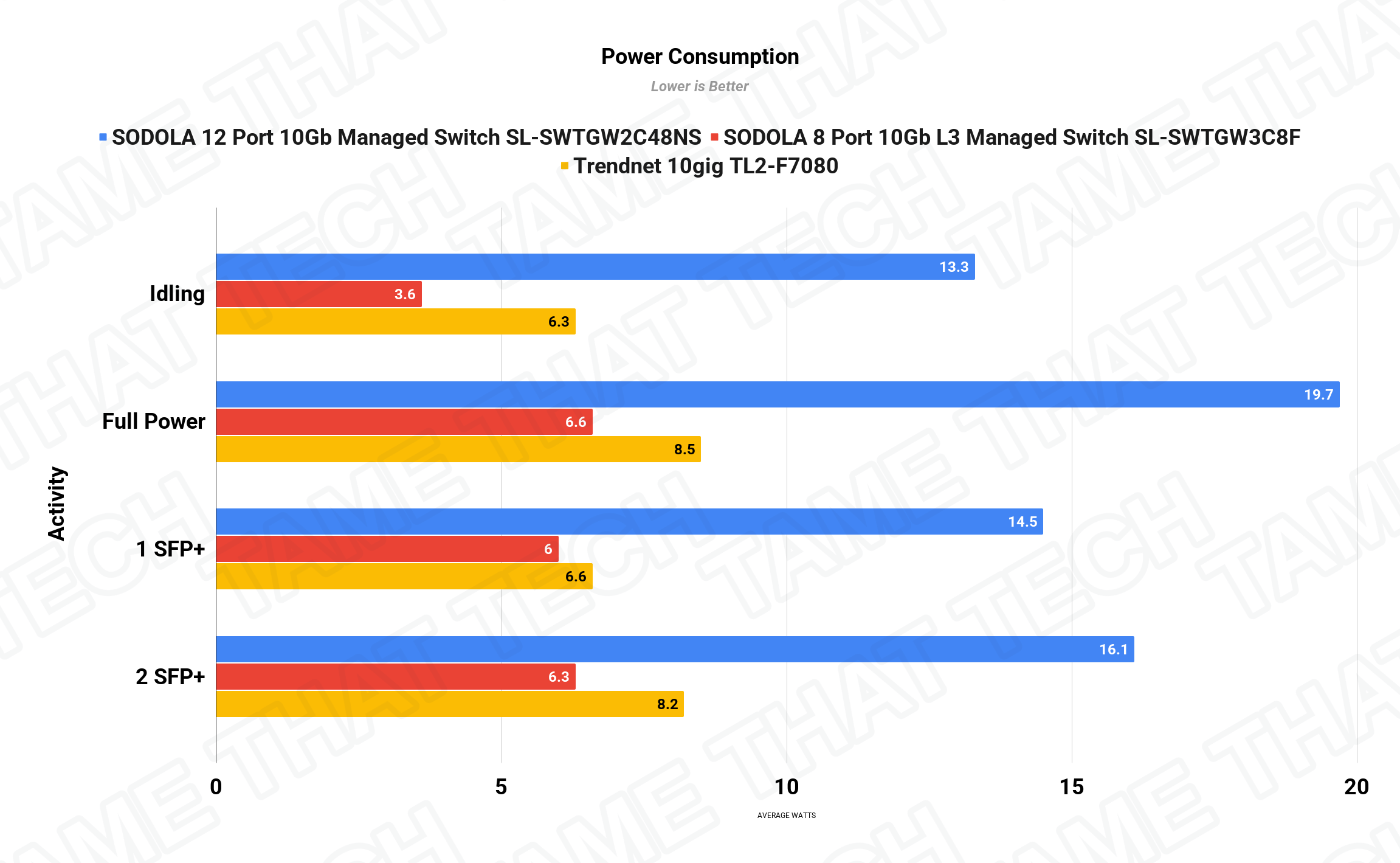
These run 24/7, so a few watts matters over a year:
- SODOLA 12-port: spec’d ~45.8 W max; idle sits well below that, but each active 10GBase-T port adds a noticeable chunk (10G copper PHYs are hungry). The hungriest of the three by design — still far more efficient than enterprise chassis.
- SODOLA 8-port L3: no published max, but fanless SFP+ boxes of this class sit in the teens to low-20s of watts under typical load. Lowest idle of the three — very gentle on the power bill.
- TRENDnet: clear spec — 23.5 W max; idle just over half the 12-port’s idle draw. The middle: hungrier than the fanless 8-port, noticeably more efficient than the 12-port hybrid.
Real-World Transfer Performance
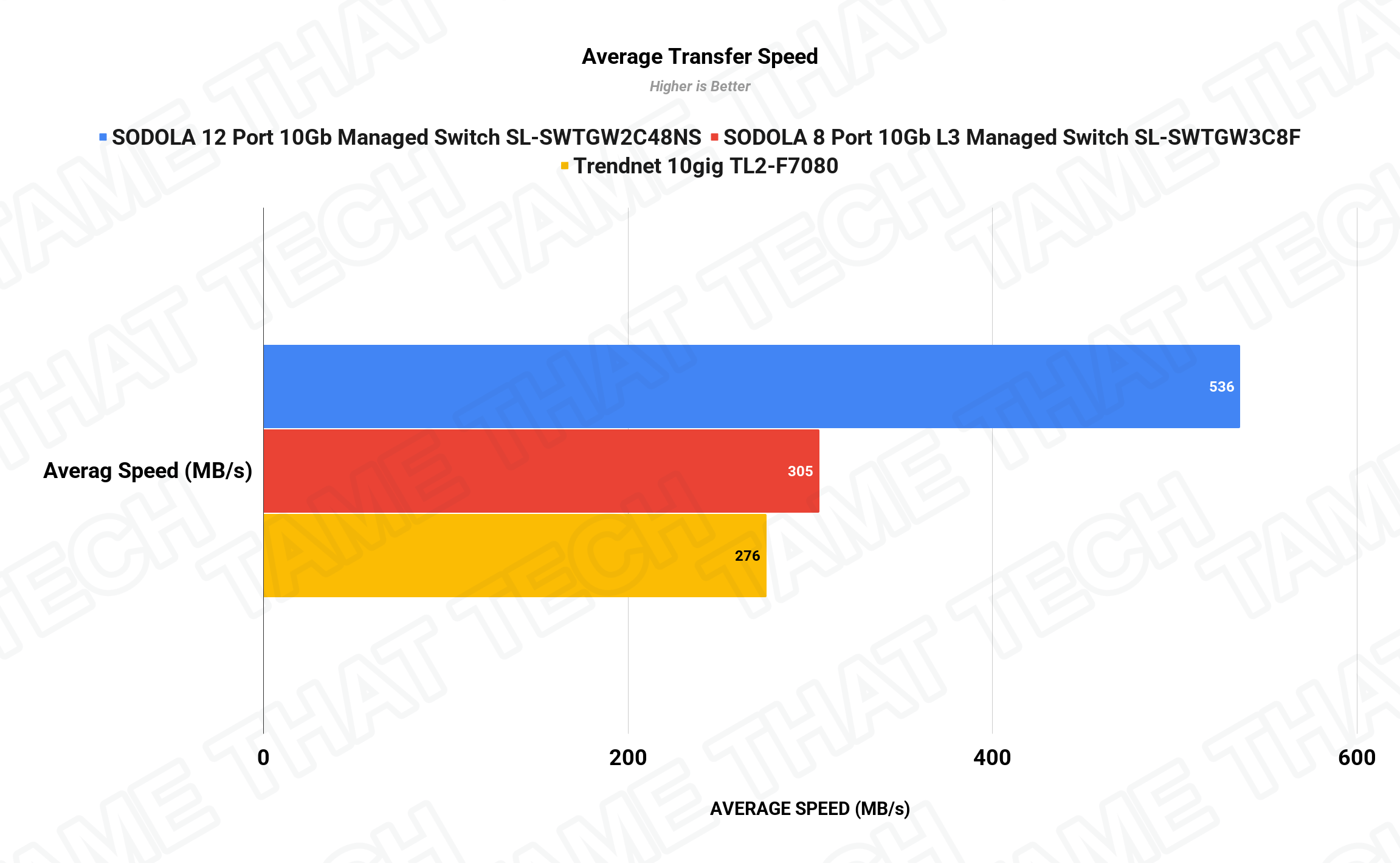
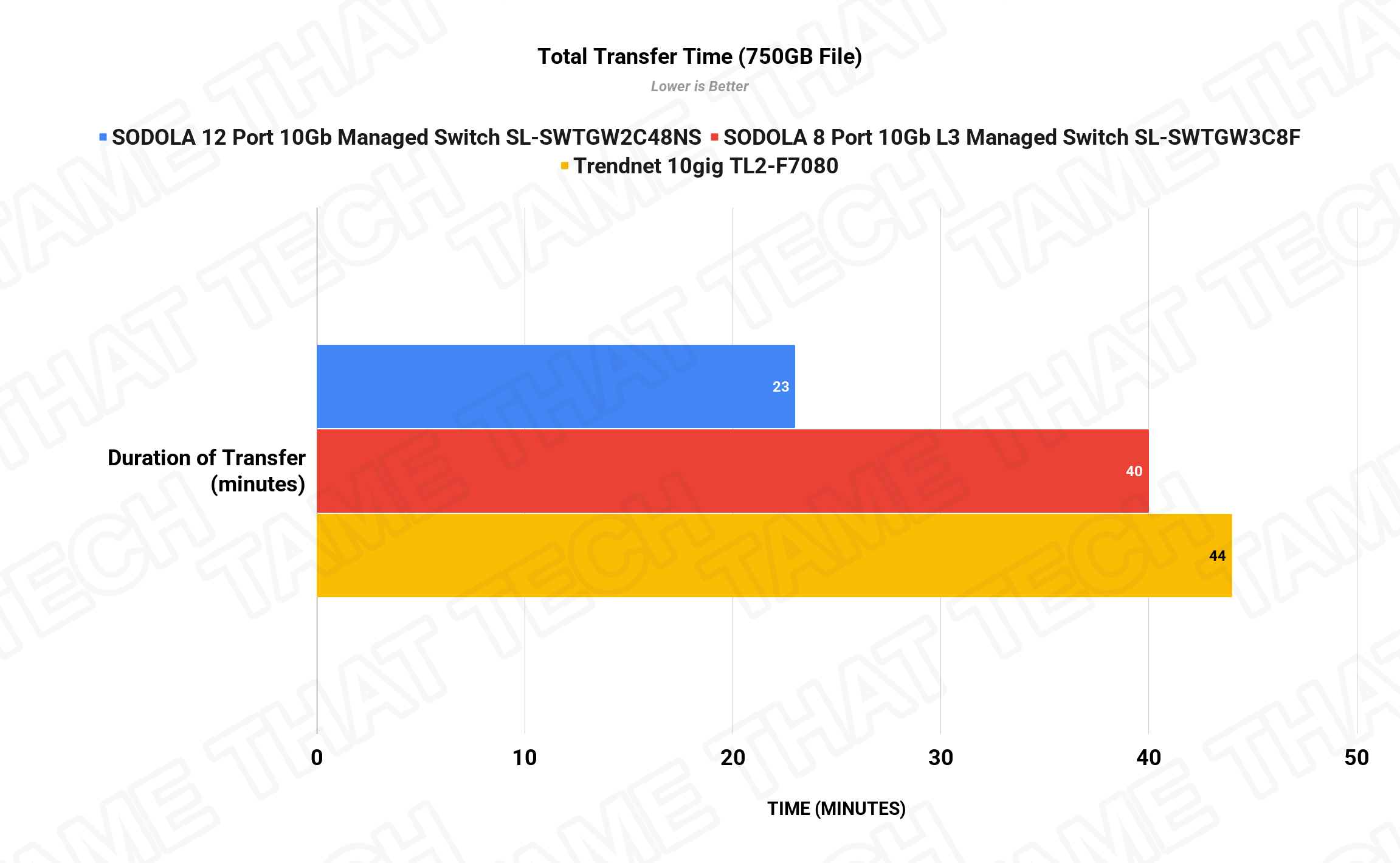
Single-stream: each switch pushed essentially line-rate 10G on a single iperf3 stream with good NICs, proper cables, and reasonable jumbo-frame/offload config — no surprise losers.
Multi-stream / all-ports: all three held full or near-full bandwidth per link with concurrent iperf3 sessions and file copies, including LACP trunks. The SODALA 12-port’s 240 Gbps backplane and the TRENDnet’s 160 Gbps handled multi-port saturation nicely; the SODOLA L3 also did fine — even while doing inter-VLAN routing.
Inter-VLAN routing (where features diverge):
- SODOLA 8-port L3: real L3 at the switch — VLAN interfaces, static routes, RIP, OSPF, per-subnet DHCP.
- TRENDnet L2+: static IPv4/IPv6 routes + inter-VLAN routing — great for offloading simple routing between a few VLANs, but no dynamic routing protocols.
- SODOLA 12-port: effectively L2-only — VLANs, LACP, STP, QoS, multicast, DHCP snooping, but no routing stack.
In routed throughput tests, both the SODOLA L3 and TRENDnet kept up with full 10G line rate for realistic homelab scenarios.
Usability & Community Notes
- SODOLA 12-port: complaints center on noise, a basic (not enterprise-polished) web UI, and access issues — set your PC to the same subnet as the default management IP (typically 192.168.2.x), browse to 192.168.2.1, and save the configuration so changes survive a reboot. Some reviews mention packet loss/instability from earlier models on the same listing — update firmware and burn-in test hard at first.
- SODOLA 8-port L3: powerful but not beginner-friendly — the UI exposes MSTP, ERPS, full ACLs, RIP/OSPF, DHCP options, IGMP/MLD snooping, MVR. Also, SFP+ ports often default to 10G/2.5G negotiation — plugging in a 1G SFP may need a port-mode change to 10G/1G or the link won’t come up. Cheap no-name gear = limited future firmware.
- TRENDnet: the opposite story — solid (not crazy-deep) feature set, polished docs/SNMP/CLI, lifetime warranty in many regions, NDAA/TAA compliance. Negatives: SFP+ only (copper needs modules that add cost/heat), not silent, and static routing is limited in scale.
Which One Should You Buy?
- SODOLA 12-port hybrid if: you need a mix of 10GBase-T and SFP+ in one box, want maximum 10G ports for the money, it’s going in a closet/garage/rack where fan noise doesn’t matter, and you’re comfortable with a basic OEM web UI.
- SODOLA 8-port 10G L3 fanless if: you need absolute silence near you, want a real L3 core (inter-VLAN routing, DHCP server, even RIP/OSPF), run mostly SFP+ fiber/DAC, and don’t mind a steeper learning curve.
- TRENDnet TL2-F7080 if: you want a brand-name business-grade switch with proper docs/support, robust L2+ features plus simple static routing, and it’s going in a small business, school, lab, or serious homelab where reliability and a lifetime warranty beat squeezing every feature out of the silicon.
The bottom line
All three of these budget switches move real 10G traffic — there’s no spec-sheet loser here. The decision comes down to what you’re optimizing: port density and copper (SODOLA 12-port), silence and routing (SODOLA 8-port L3), or reliability and support (TRENDnet). Pick the one that matches where it lives and what it has to do, and you’ll be happy with any of them.
— Tame That Tech Minion
Discussion