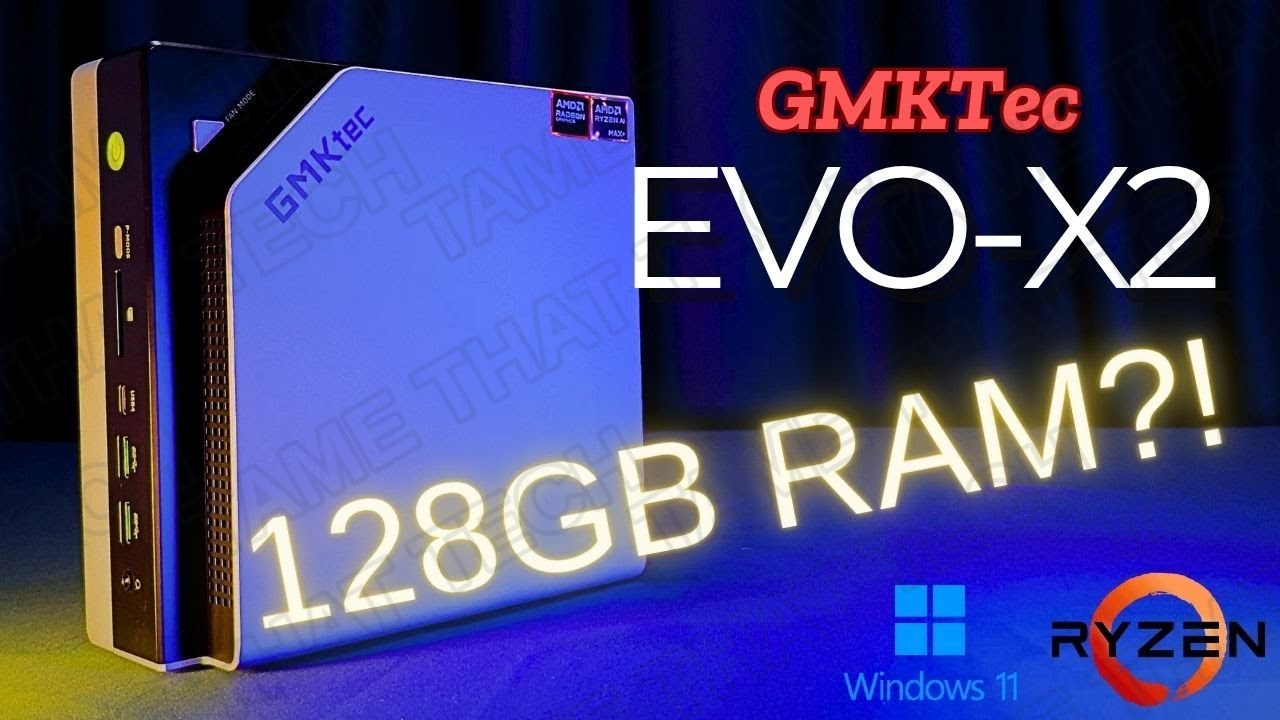
GMKtec EVO-X2 AI Max+ 395 Review: The Ultimate AI Desktop Mini PC?
Today we’re taking a deep dive into what might just be the most powerful mini PC of 2025: the GMKtec EVO-X2 AI Max+ 395. This tiny box claims to bring AI workstation power and serious gaming performance right to your desktop. So, does it deliver? And is it worth the price?
Short version: it’s the most capable compact PC we’ve tested — a legit local-AI workstation that games like a laptop with an RTX 4060/4070 — but content creation is a letdown, and at over $2,000 shipped, the value story gets complicated.
TL;DR — The 10-second verdict
| What it is | A shoebox-sized mini PC with AMD Ryzen AI Max+ 395 (16 Zen 5 cores), Radeon 8060S iGPU, XDNA2 NPU, and 128 GB LPDDR5X-8000 |
| Who it’s for | Local-AI enthusiasts, researchers, and devs who want to run large LLMs on their desk without a big tower; gamers who want 1080p-1440p in a tiny chassis |
| The headline | 126 TOPS total AI, 128 GB of RAM, and gaming between an RTX 4060 and 4070 laptop — in a box that fits a shoebox |
| The catch | RAM is soldered (no upgrades), content creation is genuinely poor (1h37m for a 4-min 1080p render), and it’s over $2,000 shipped + possible import tariffs |
| Our take | A phenomenal engineering showcase and a real AI box — but for most people, the price makes it a toy, not a tool |
| Where To Buy (Affiliate Links) | Amazon · Mavely · JoyLink |
| Video Review | YouTube |
Hardware & Specs
| Component | Specification |
|---|---|
| CPU | AMD Ryzen AI Max+ 395 — 16 Zen 5 cores / 32 threads, up to 5.1 GHz |
| GPU | AMD Radeon 8060S — 40 RDNA 3.5 compute units, integrated |
| NPU | XDNA2 — 50 AI TOPS dedicated, 126 TOPS total system |
| Memory | 128 GB LPDDR5X-8000 — soldered (not upgradable) |
| Storage | 2 TB PCIe 4.0 SSD + second M.2 slot (up to 8 TB total) |
| Networking | 2.5 GbE (Realtek) · Wi-Fi 7 · Bluetooth 5.4 |
| Display | Up to 4 displays — HDMI 2.1 (8K60) · DisplayPort 1.4 (8.1 Gbps) · USB4 |
| Front I/O | P-Mode button · SDXC slot · 1× USB4 · 2× USB 3.2 (10 Gbps) · combo audio |
| Rear I/O | DC-in · 2.5 GbE · 1× USB 3.2 · DP 1.4 · HDMI 2.1 · 2× USB 2.0 |
| Cooling | Dual fans + vapor chamber, RGB (13 modes, chassis-button controlled) |
It’s basically a desktop-class APU smashed into a shoebox — 16 Zen 5 cores, a Radeon 8060S with 40 RDNA 3.5 compute units, and 128 GB of LPDDR5X-8000. The catch: that RAM is soldered, so what you buy is what you keep. The all-metal chassis weighs about 3.6 pounds and feels solid, though the main door is a bit flimsy if pulled wrong, and the Fan Mode / P-Mode buttons didn’t visibly do anything in our testing (likely software-gated, which we opted not to use).
Local AI — The Headline Feature
The EVO-X2 is a legit local AI workstation. In LM Studio, the 128 GB of RAM makes running massive 70-billion-parameter LLMs a possibility:
- Anything up to 32B runs just fine with usable token rates
- Beyond that, speeds drop too low for production use — but if your goal is running huge models locally and you don’t mind slow tokens, it can do it
- One quirk: initially we set 96 GB VRAM in the BIOS and models failed to load — dropping to 64 GB RAM / 64 GB VRAM worked. It’s still partitioned, not unified like Apple’s approach
If you’re a researcher, dev, or just someone who wants to run huge models locally, this box could be the solution — though for faster inference, the next NPU generation is probably worth waiting for.
Content Creation — The Letdown
Despite the 8060S’s compute muscle, content creation was a disappointment:
- We couldn’t scrub a 1080p timeline without lag
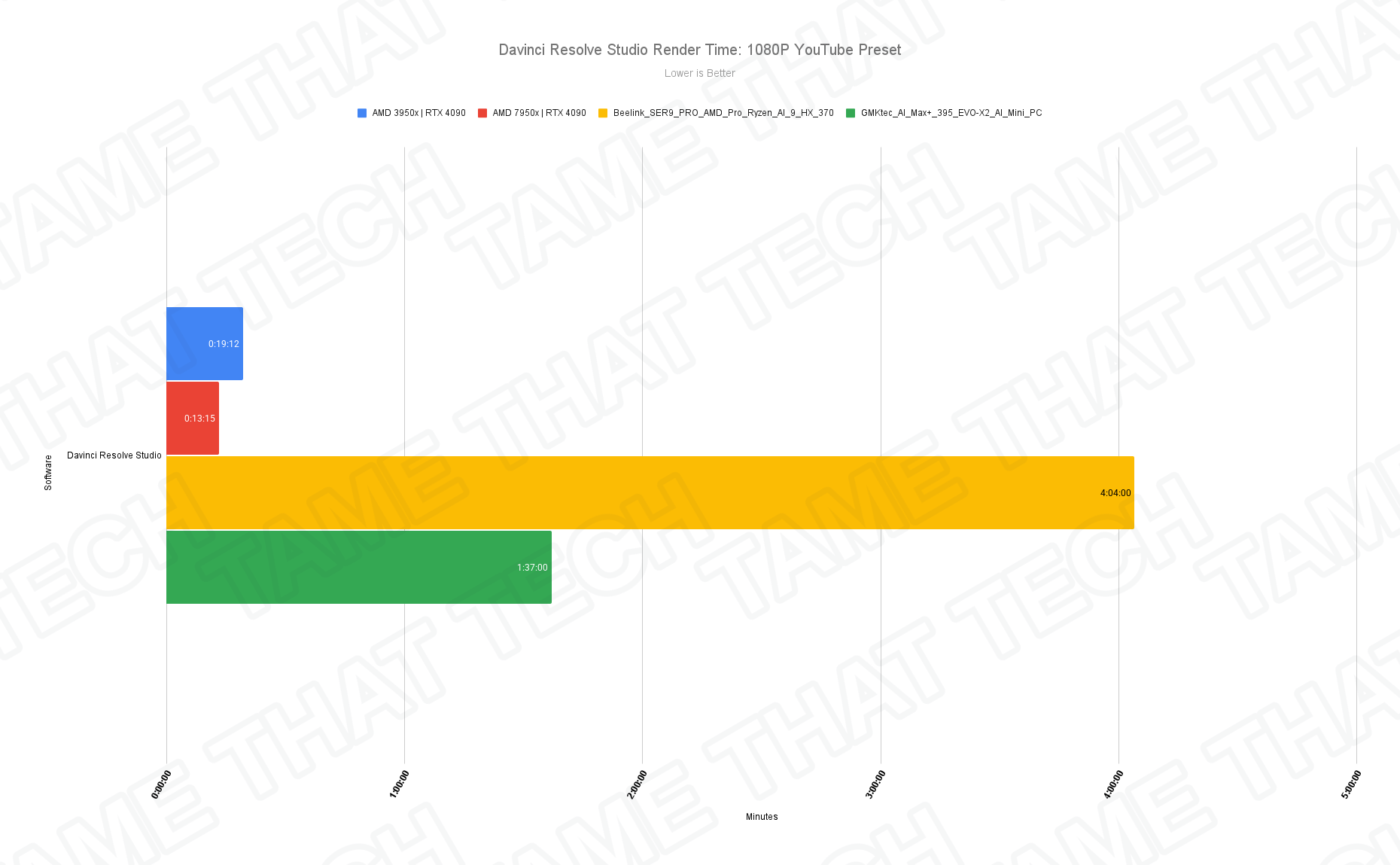
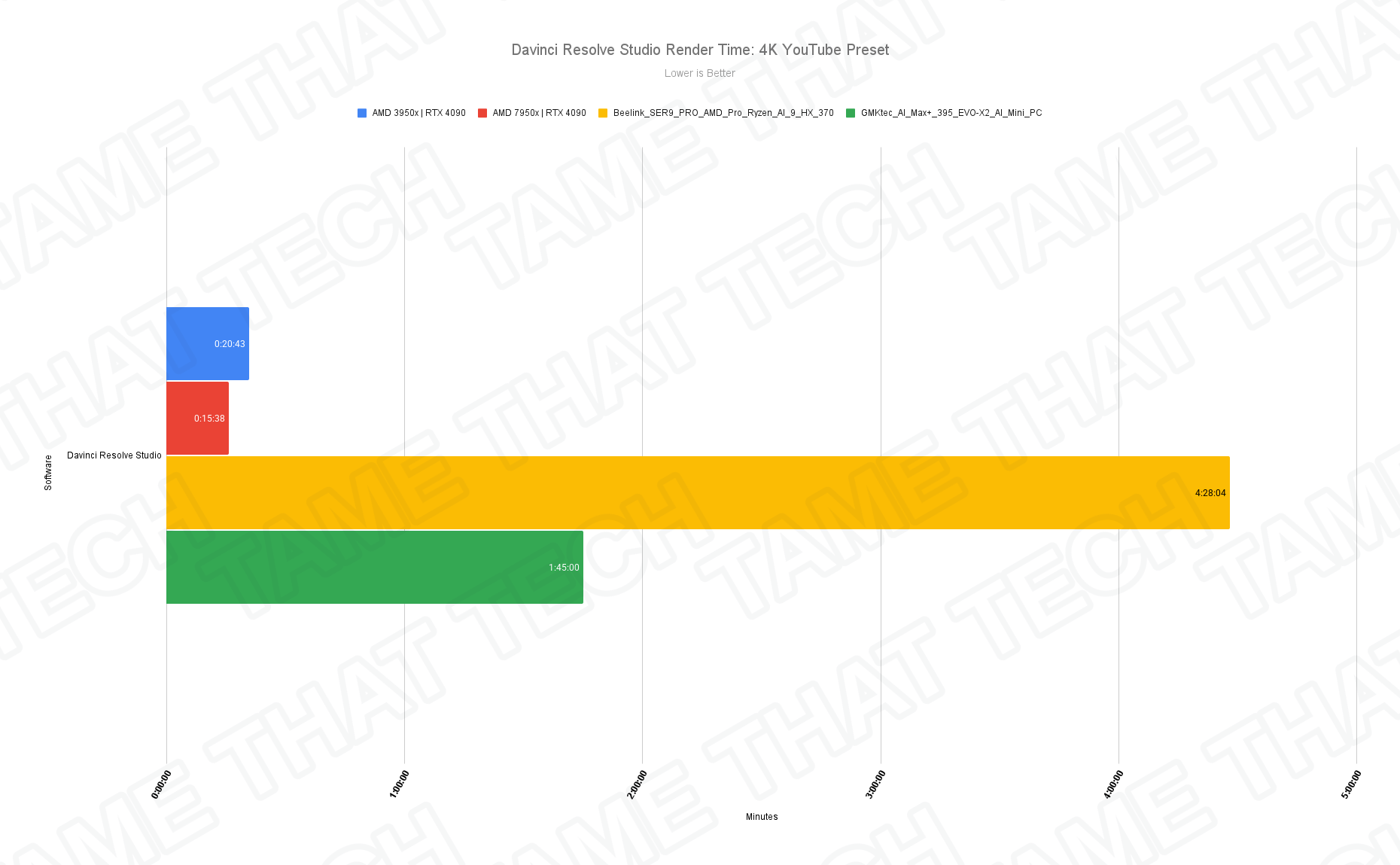
- Rendering a 4-minute 1080p video took 1 hour 37 minutes; the 4K version took 1 hour 45 minutes
- For reference, our editing rig (7950X + RTX 4090) renders the same video in 15 minutes
This is far too slow for any real content creation — driver/software optimization is clearly not there yet for the 8060S in Resolve.
Gaming Performance
Settings: MEDIUM presets, FSR ON, no frame generation.
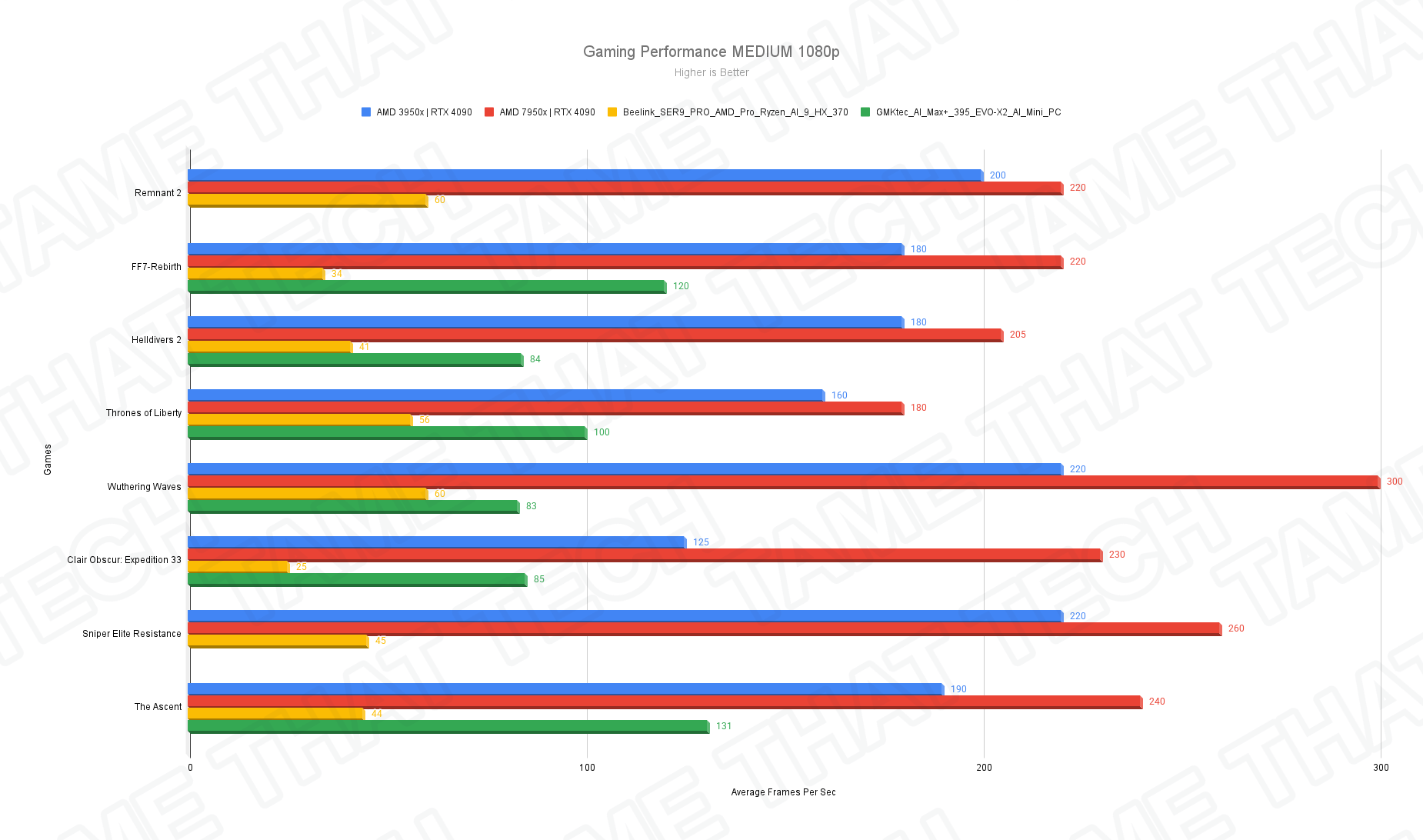
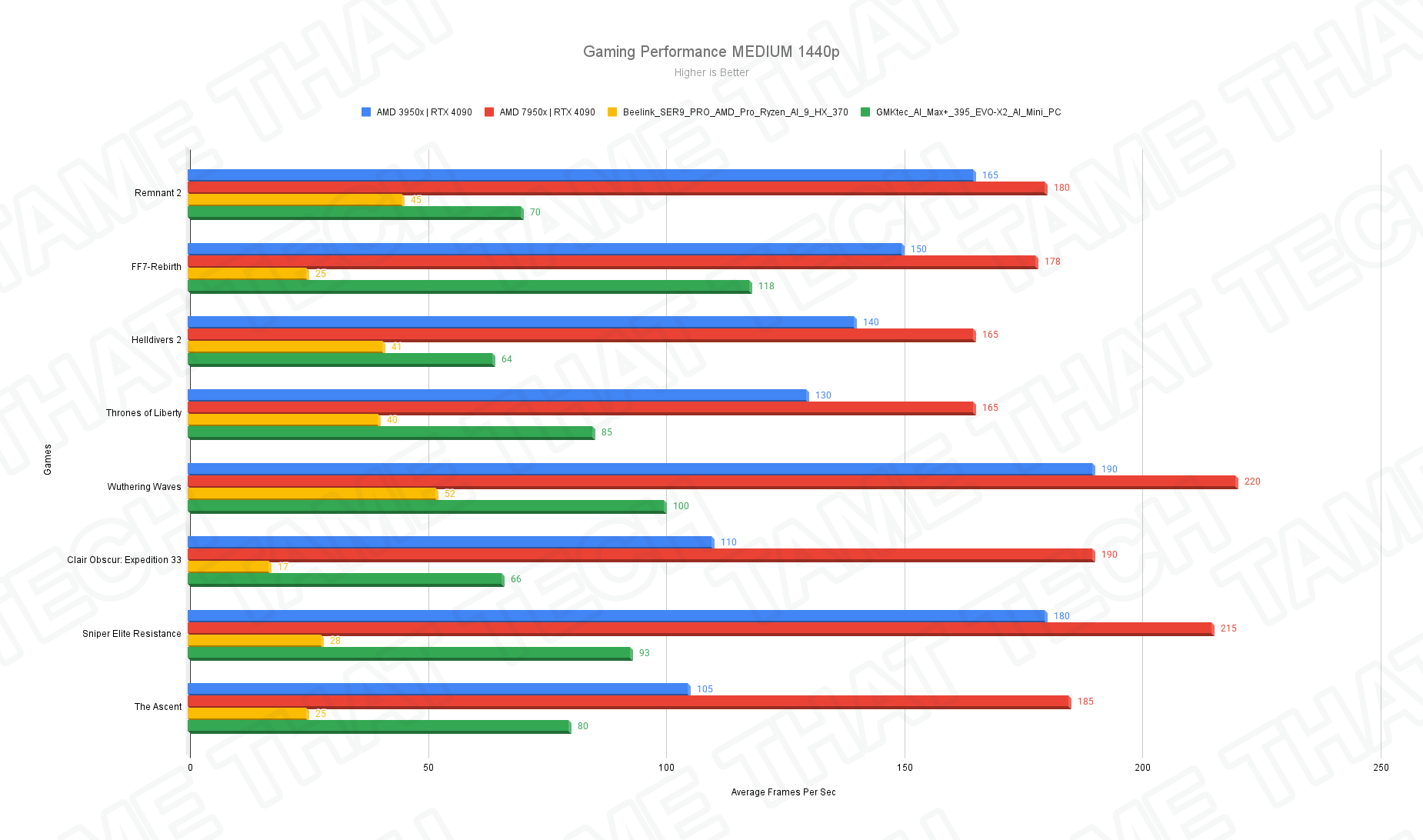
Here the EVO-X2 genuinely impressed us — it performs much better than any other mini PC we’ve tested, slotting right between an RTX 4060 and 4070 laptop GPU. All games hit very playable frame rates at medium settings, and with up to 96 GB of shared memory for the GPU you’ll never hit a VRAM wall. We were especially impressed with Helldivers 2 and Clair Obscur: Expedition 33 — games that tend to bring anything without a dedicated GPU down to its knees.
Cooling, Noise & Power
GMKtec nailed the thermals: the dual-fan vapor-chamber combo stays surprisingly quiet.
- Idle: under 35 dB in Performance Mode
- Full load: peaks around 49 dB
- Power: a very respectable 10–13 W idle, max draw 220 W at full load
The RGB fans are programmable with 13 lighting modes — the only downside is they’re chassis-button controlled, not software-controlled.
Price & Availability
Here’s where it gets complicated. The EVO-X2 costs over $2,000 shipped — and ours shipped from Hong Kong via DHL with additional tariffs collected before delivery. Compared to other mini PCs (Mac Studio M3 Ultra, upcoming Beelink/MINISFORUM AI models, the Framework Desktop), the EVO-X2 stands out for unmatched AI acceleration and RAM capacity. But there are real quirks: soldered RAM, USB 2.0 ports in 2025, and that price.
Even as an enthusiast, we felt this is a steep price for what is ultimately a toy for most workflows — it can’t do the real work (content creation) that many would buy it for, and the AI use case is strong but niche.
Pros
- Unmatched local AI: runs 70B-class LLMs, 126 TOPS total
- 128 GB of LPDDR5X-8000 — more RAM than most desktop workstations
- Gaming between an RTX 4060 and 4070 laptop — best-in-class for a mini PC
- Quiet dual-fan vapor-chamber cooling; 10–13 W idle
- Wi-Fi 7, 4 displays, 8K60 over HDMI
Cons
- RAM soldered — no upgrades, ever
- Content creation is a letdown (1h37m for a 4-min 1080p render)
- Over $2,000 shipped + potential import tariffs
- USB 2.0 ports in a 2025 flagship
- Flimsy main door; Fan Mode/P-Mode buttons appear non-functional
The bottom line
The GMKtec EVO-X2 is a phenomenal engineering showcase — the most powerful compact PC we’ve tested, with legit local-AI chops and impressive gaming. But it’s expensive, the RAM is locked, and it can’t do the creator workloads many would expect. If you’re an AI researcher or enthusiast who wants max RAM and local LLMs in a shoebox, it’s a unique machine. For most people, though, it’s a very capable toy at a workstation price.
— Tame That Tech Minion
Discussion