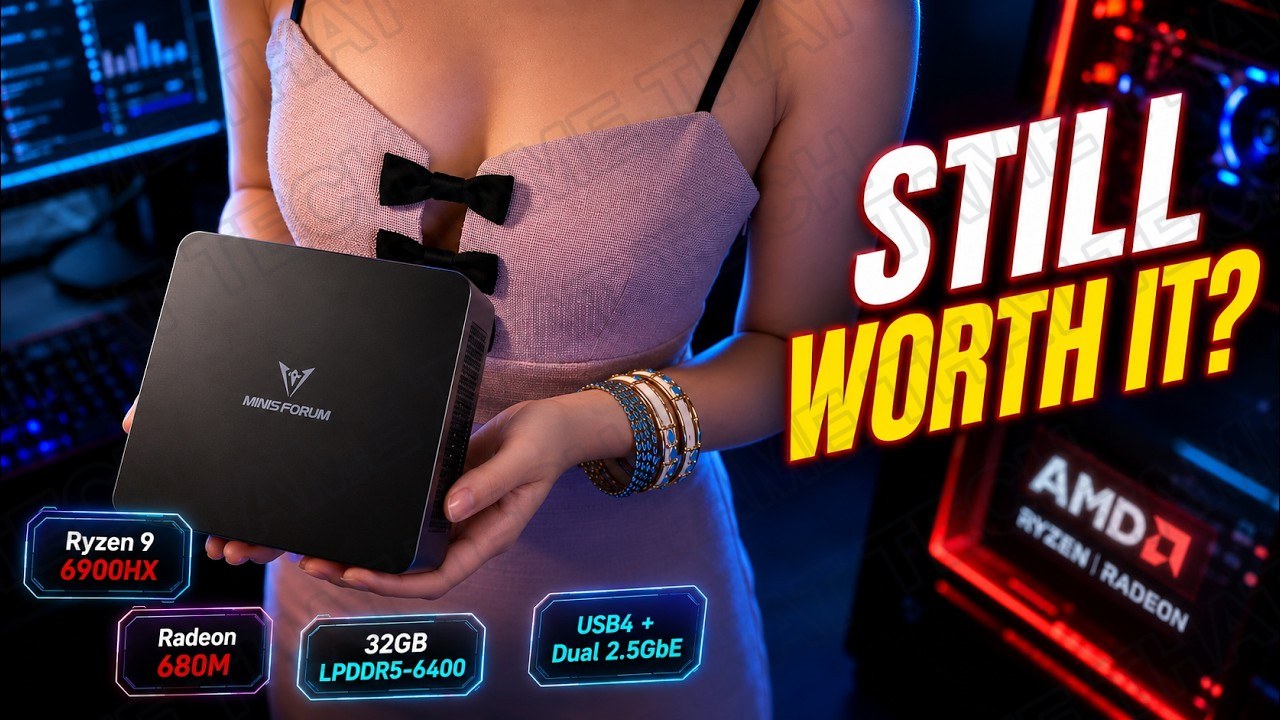
Minisforum UM690L Slim Review: Quiet, Fast, and Surprisingly Strong
Is it still possible to get workstation-class performance and decent gaming out of a mini PC that sips power from the wall? The Minisforum UM690L Slim makes a strong case that yes, it is. Inside a surprisingly compact chassis sits an AMD Ryzen 9 6900HX — eight cores, sixteen threads, and a surprisingly potent Radeon 680M integrated GPU — backed by 32 GB of high-speed LPDDR5.
Short version: this is a versatile, quiet little workhorse that punches well above its class for creative workloads and local AI. The catch is that the RAM is soldered and can’t be upgraded, and the integrated GPU has limits with brand-new AAA games. Here’s everything, measured.
TL;DR — The 10-second verdict
| What it is | A compact mini PC with an AMD Ryzen 9 6900HX laptop chip, Radeon 680M integrated graphics, and 32 GB soldered LPDDR5-6400 |
| Who it’s for | Content creators, homelab owners, and local-AI tinkerers who want workstation-class CPU power in a quiet, low-power box |
| The headline | 8 cores / 16 threads, PugetBench DaVinci score over 35,000, 6 W idle, whisper-quiet — all in a palm-sized chassis |
| The catch | RAM is fully soldered (locked at 32 GB), and the iGPU chokes on cutting-edge next-gen games |
| Our take | One of the most well-rounded compact workstations we’ve tested — if you don’t need to upgrade memory later |
| Where To Buy (Affiliate Links) | Amazon · Mavely · JoyLink |
| Video Review | YouTube |
Hardware & Specs
| Component | Specification |
|---|---|
| CPU | AMD Ryzen 9 6900HX — 8 cores, 16 threads, Zen 3+ (Rembrandt), 6 nm |
| GPU | AMD Radeon 680M (RDNA2) — 12 compute units, integrated |
| Memory | 32 GB LPDDR5-6400 quad-channel, soldered (not upgradable) |
| Storage | 1 TB PCIe Gen4 NVMe SSD + one free M.2 2280 slot for expansion |
| Networking | Realtek 2.5GbE · MediaTek Wi-Fi 6E · Bluetooth 5.2 |
| Front I/O | Power button · 2× USB 3.2 Gen2 Type-A · 3.5 mm combo audio · recessed Clear CMOS button |
| Rear I/O | DC-in (120 W adapter) · HDMI 2.1 · USB-C 40 Gbps (video + 100 W reverse power delivery) · DisplayPort 1.4 · 2× USB 2.0 |
| Power | 120 W AC adapter (19 V) |
The spec sheet is genuinely strong for the size class. The quad-channel LPDDR5-6400 memory bandwidth is the star of the show — it’s what makes both the iGPU and local LLM performance punch above their weight. But that same high-speed memory is soldered to the board, and that’s the biggest community talking point: you’re locked into 32 GB, period. For most tasks at this class that’s plenty — but if you think you’ll need 64 GB down the road, this isn’t the machine.
Design & Connectivity
The UM690L Slim is incredibly compact — small enough to disappear behind a monitor on the included metal VESA mount, which ships in the box along with a high-speed HDMI cable and the 120 W power brick.
Connectivity is well thought out. The USB-C port runs at 40 Gbps and supports single-cable video plus 100 W of reverse power delivery from a compatible monitor — you can literally power the whole PC over one cable. Around the back you also get HDMI 2.1, DisplayPort 1.4, a Realtek 2.5 GbE port, and two USB 2.0 ports for peripherals; up front, two USB 3.2 Gen2 Type-A ports, a 3.5 mm combo jack, and a recessed CMOS reset button. With Wi-Fi 6E and Bluetooth 5.2 on board, this makes a great compact homelab server or a clean one-cable desk setup.
Thermals, Noise & Power
Small form-factor PCs often struggle with thermals — this one handles them remarkably well.
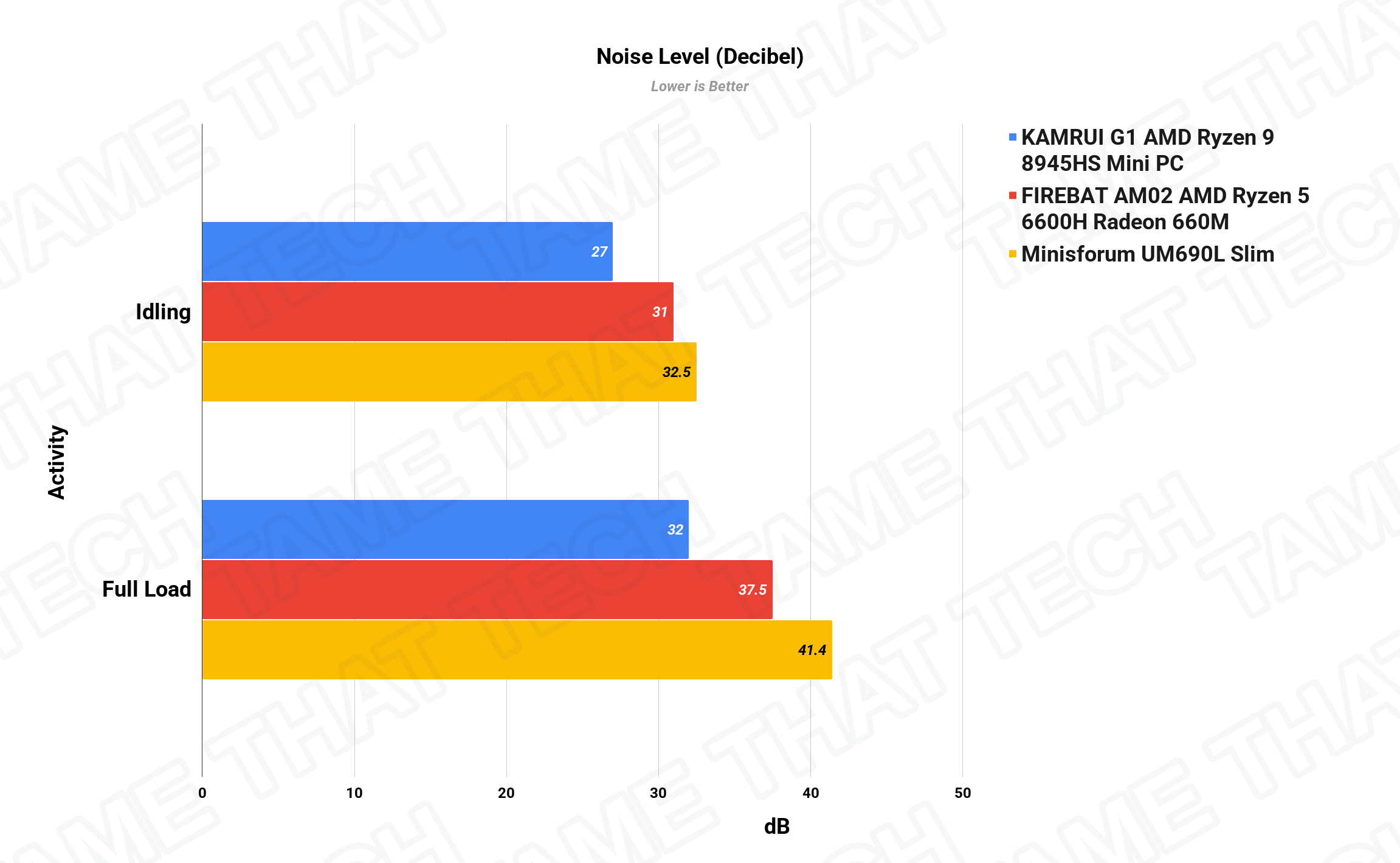
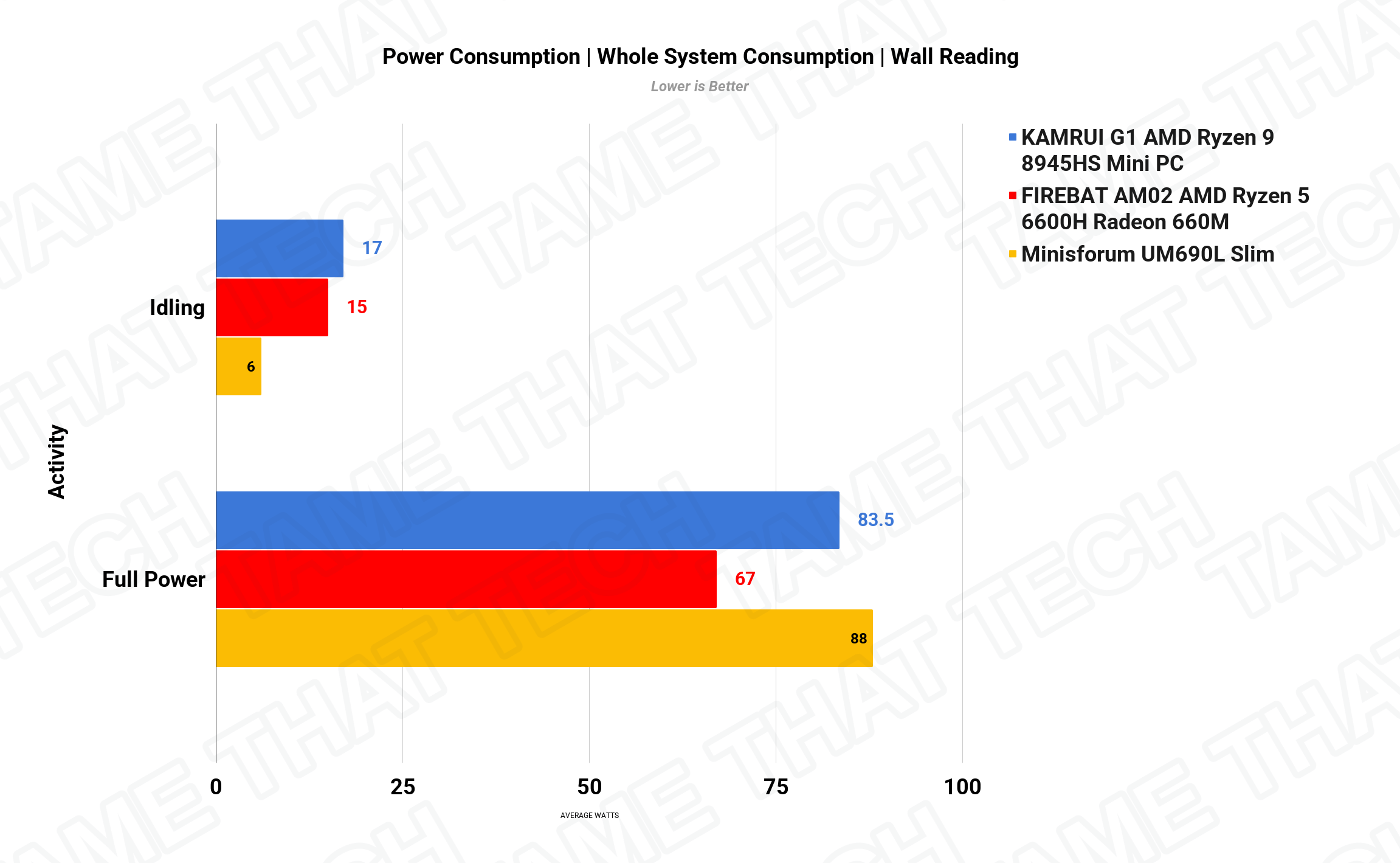
| Idle | Full load | |
|---|---|---|
| Noise | 32 dB | 41.4 dB |
| Power (wall) | 6 W | ~88 W |
Idle noise is whisper-quiet at 32 dB, and even under full load the fan tops out at 41.4 dB — an audible but steady, low-frequency hum that’s easy to ignore. Honestly, even while gaming with the fan at full tilt two feet away, we couldn’t hear it. Power draw is equally impressive: just 6 W at idle and a peak of around 88 W under maximum stress. If you’re planning a 24/7 homelab, this machine won’t wreck your power bill.
Creator Workloads — Cinebench & DaVinci Resolve
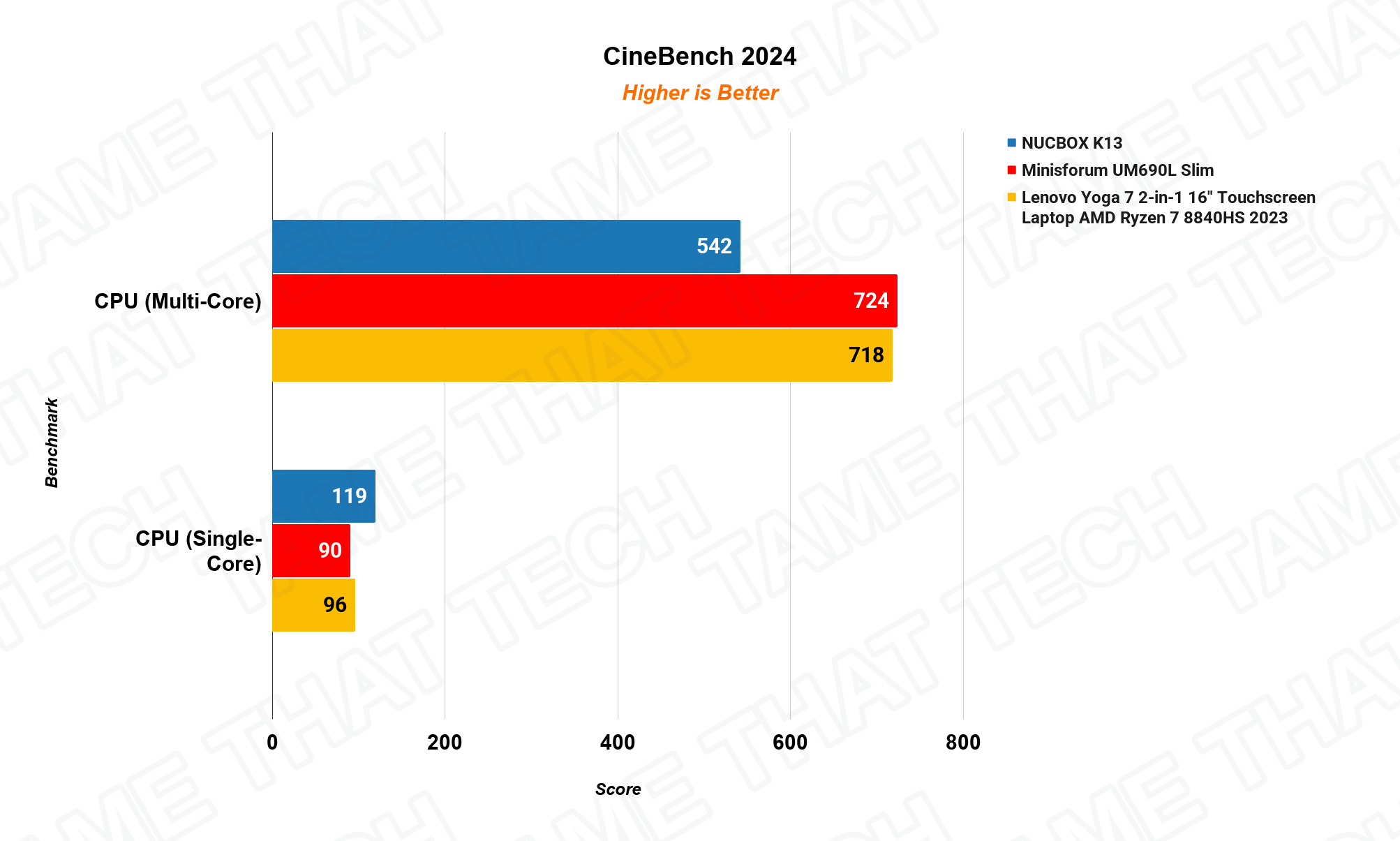
In Cinebench 2024, the multi-core score hit 724 — comfortably beating newer laptop processors like the Ryzen 7 8840HS. Single-core performance trails some similarly equipped machines, but the multi-core story here is excellent for the price.
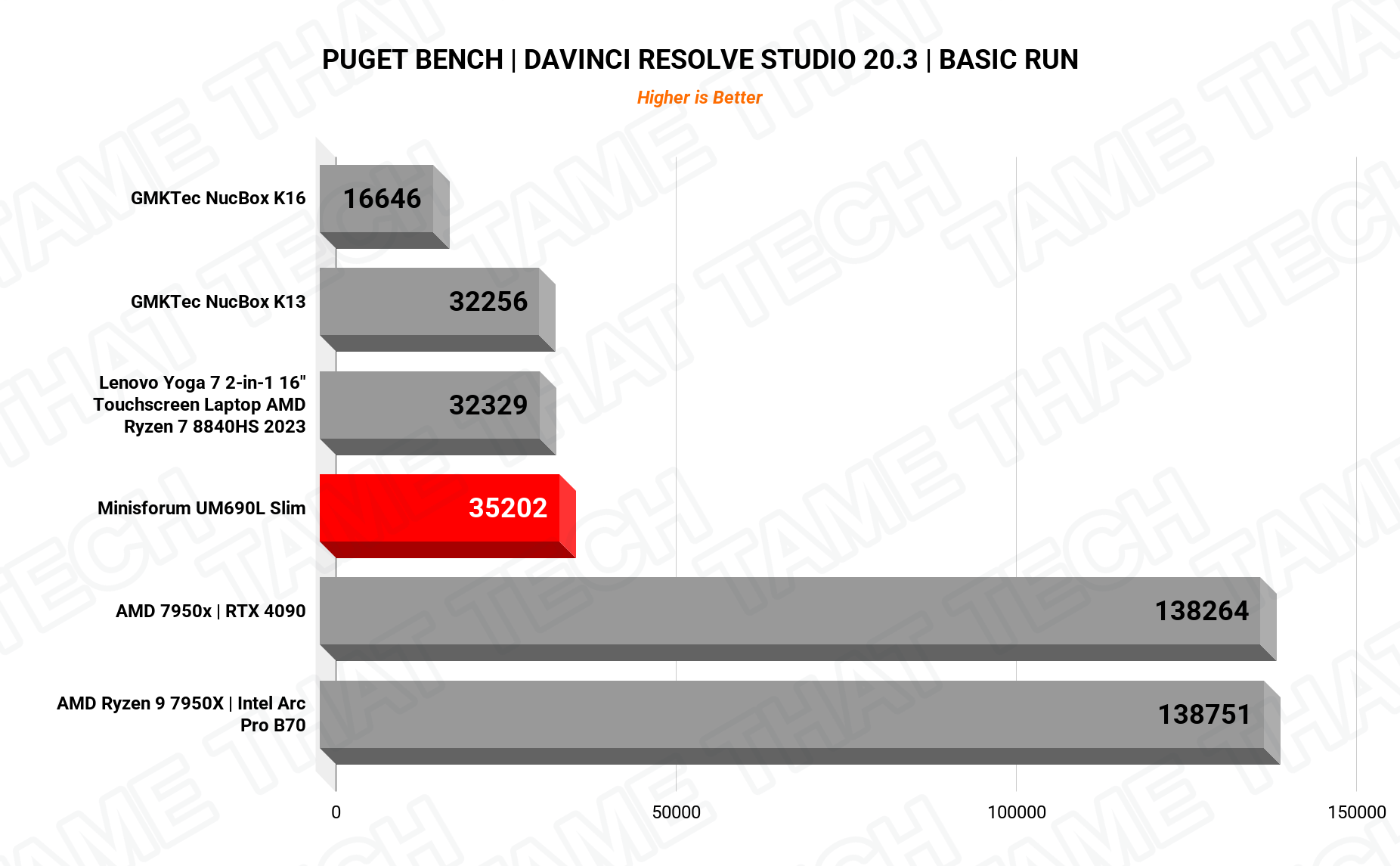
In DaVinci Resolve Studio 20.3, the PugetBench run returned an impressive overall score of 35,202 — beating both laptops and other mini PCs in its class.
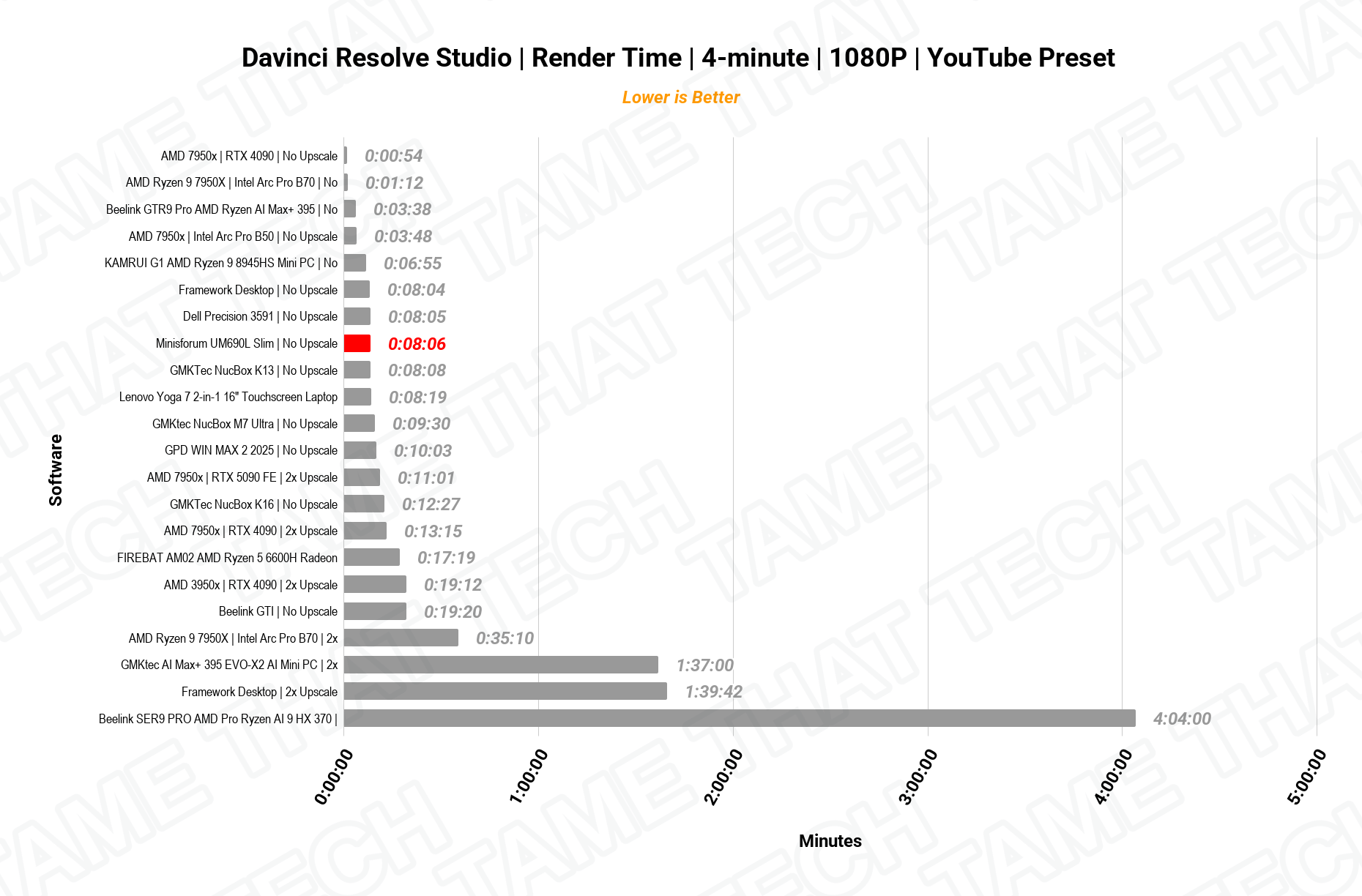
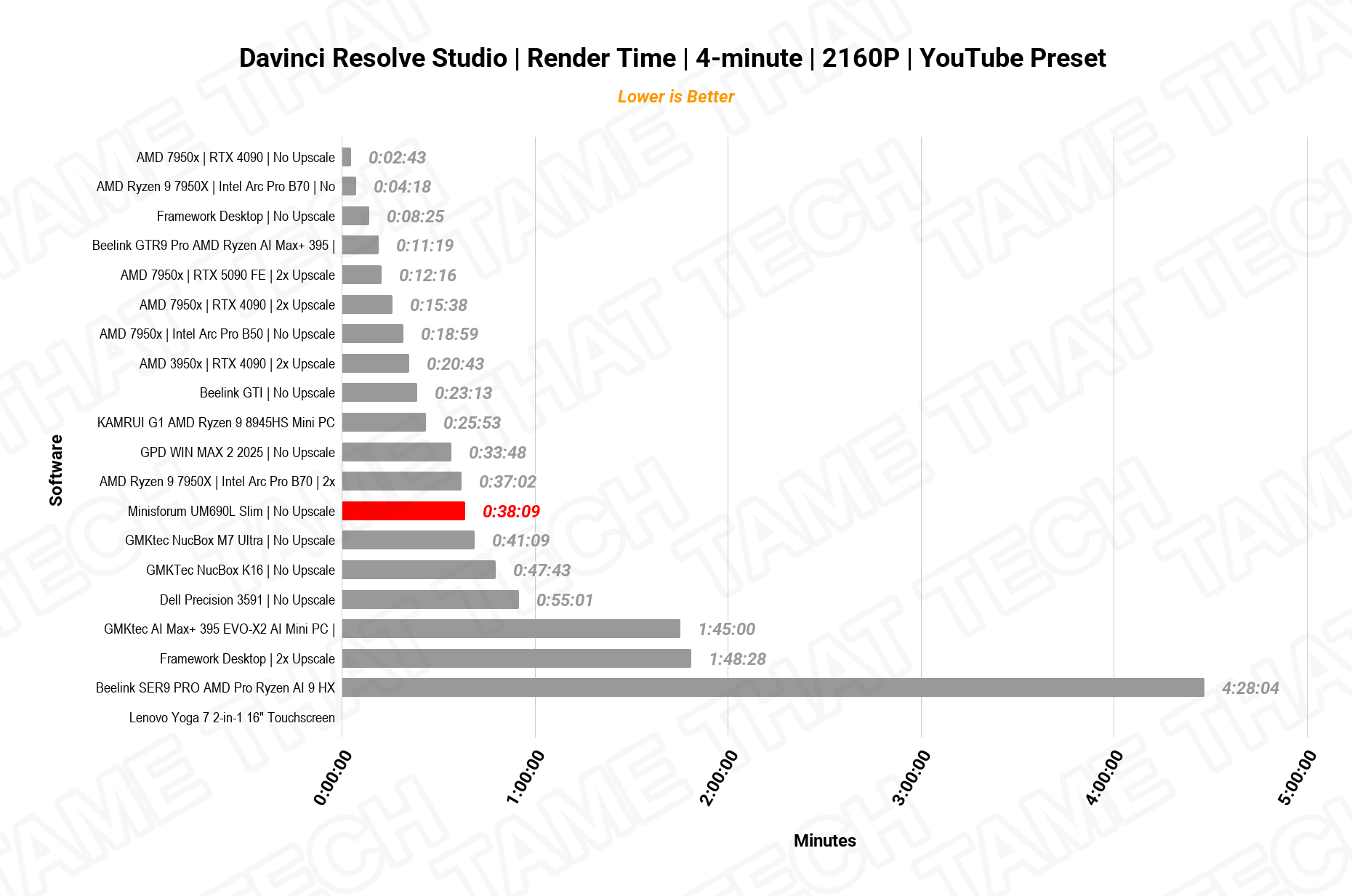
| Render (4-min project) | Time |
|---|---|
| 1080p YouTube preset | 8:06 |
| 2160p (4K) YouTube preset | 38:09 |
This little PC scrubs 1080p timelines with ease — a little lag here and there, but definitely usable. 4K scrubbing is a different story: depending on color grade and effects, it can cause major slowdown and stuttering. As for rendering, a four-minute 1080p video rendered in just 8 minutes and 6 seconds, while the same video in 4K took 38 minutes and 9 seconds. For a machine without a discrete GPU, those numbers are outstanding.
Gaming Performance
Settings: LOW quality, FSR ON (Performance mode), no frame generation — the Radeon 680M pushed as far as it’ll go across five resolutions.
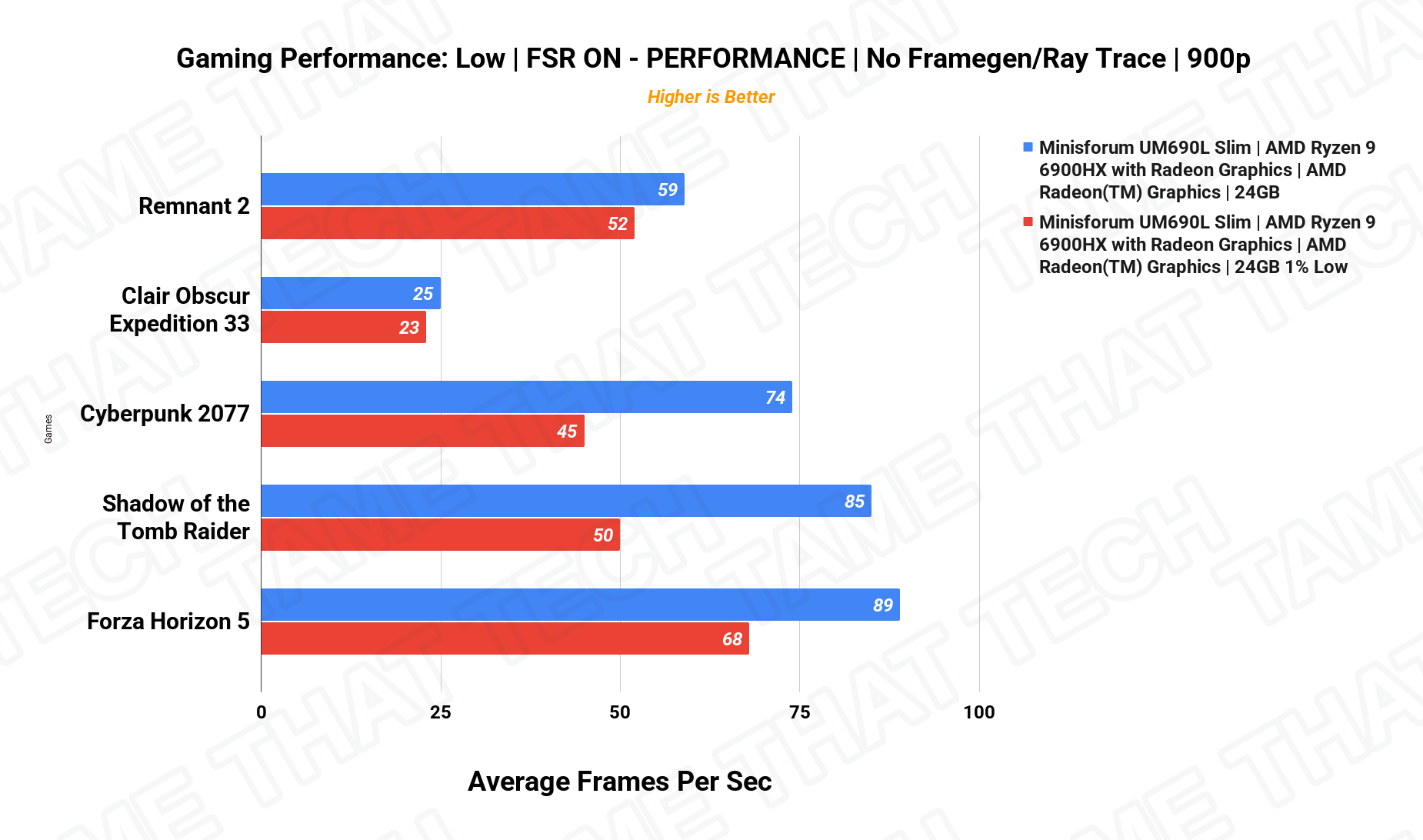
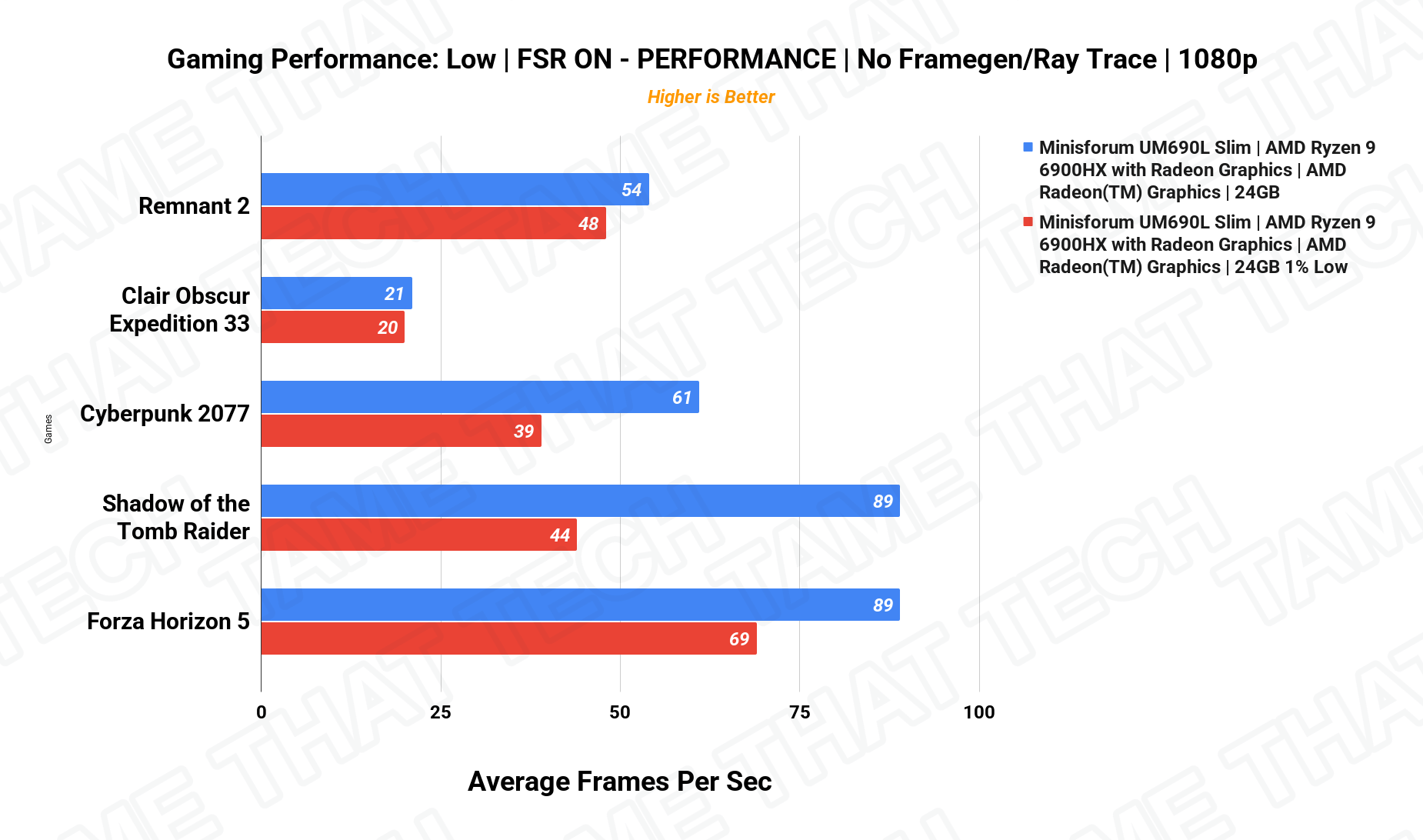
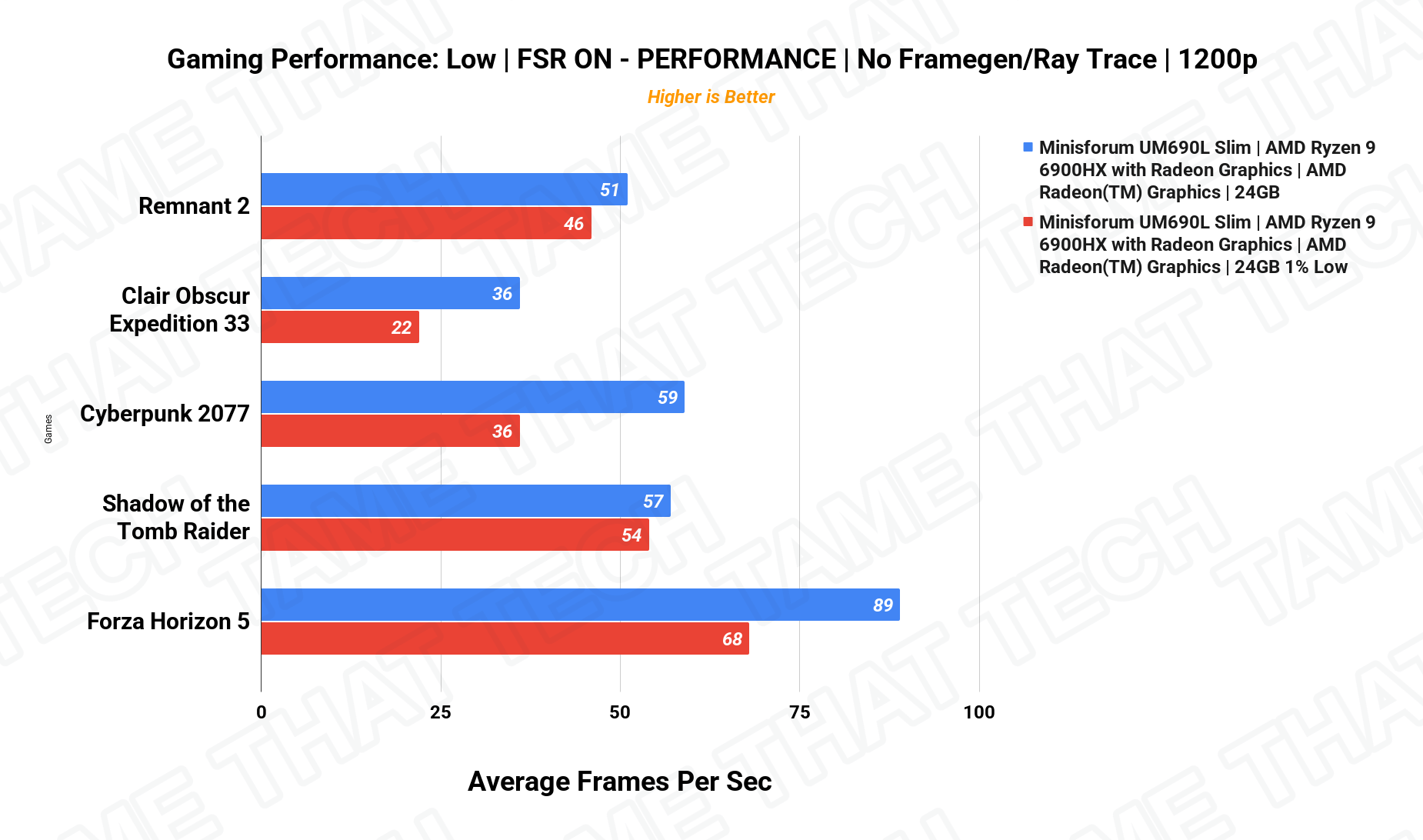
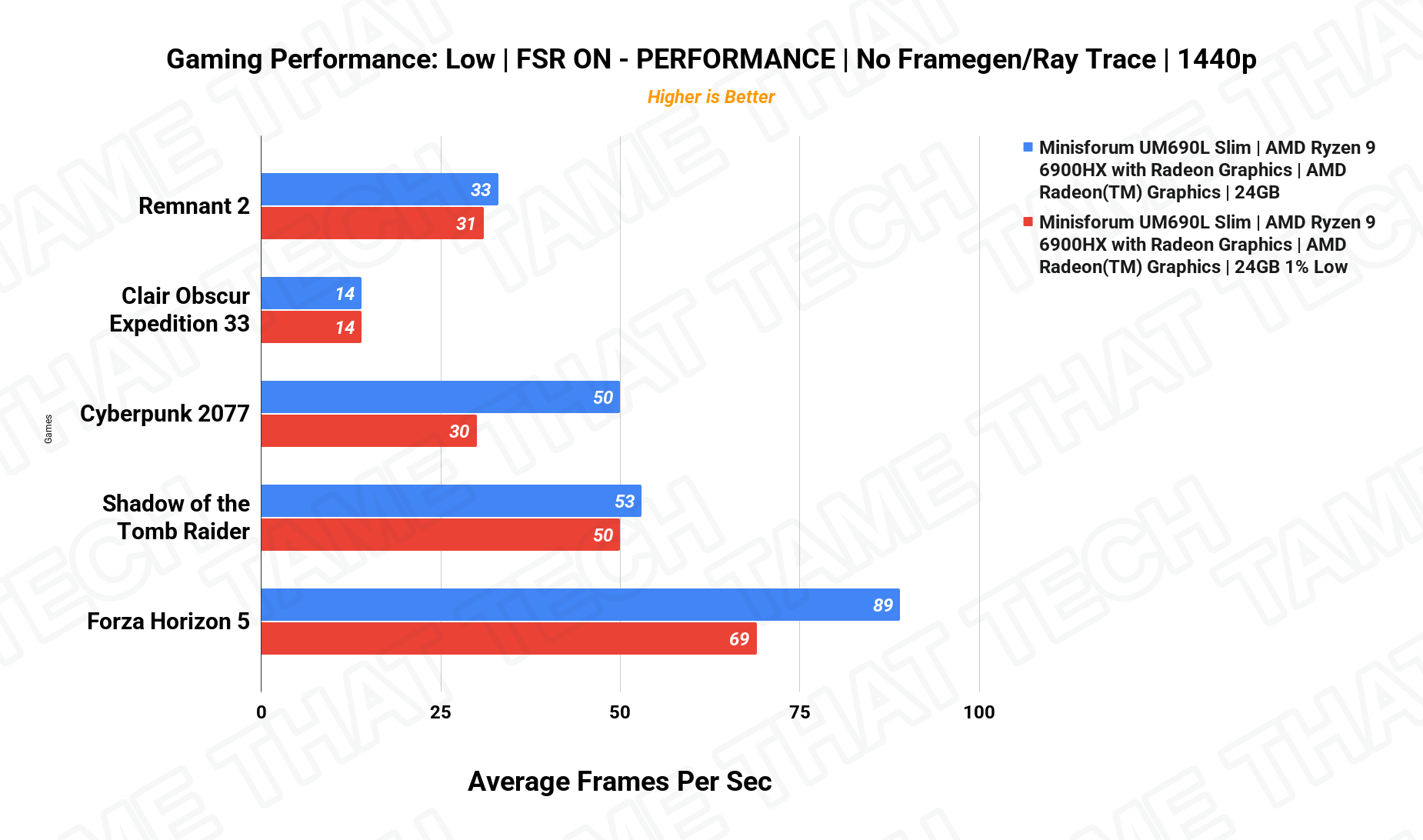
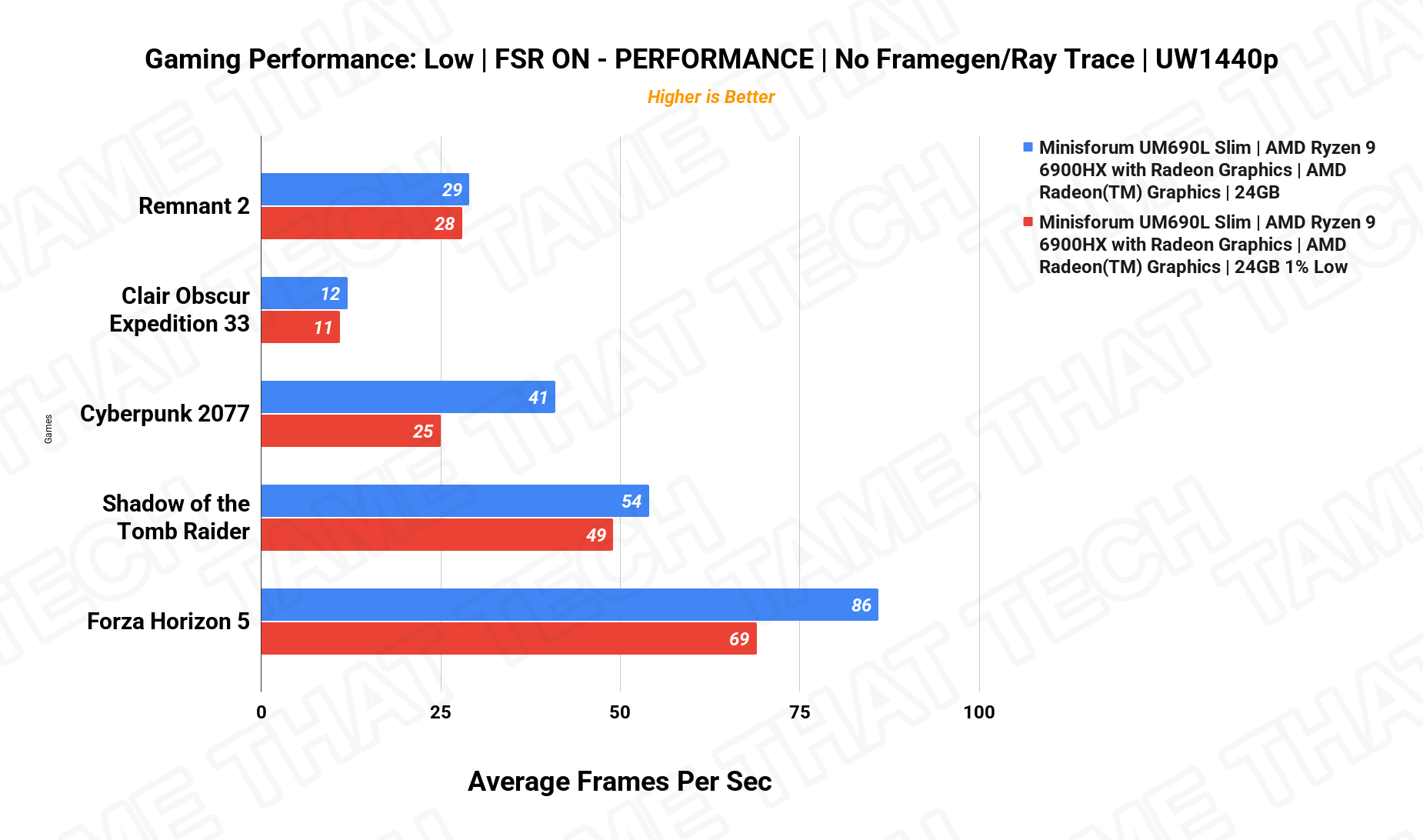
| Game (avg fps) | 1080p | 1440p |
|---|---|---|
| Forza Horizon 5 | 89 | 89 |
| Shadow of the Tomb Raider | 89 | 53 |
| Cyberpunk 2077 | 61 | 50 |
| Clair Obscur: Expedition 33 | 21 | 14 |
Forza Horizon 5 is a locked 89 fps at both 1080p and 1440p — genuinely impressive for integrated graphics. Shadow of the Tomb Raider hits 89 fps at 1080p before dipping to 53 at 1440p, and Cyberpunk 2077 is surprisingly playable at 61 fps / 50 fps.
The wall you’ll hit is with cutting-edge, next-gen titles: in Clair Obscur: Expedition 33 the integrated GPU choked, turning in a sluggish 21 fps at 1080p and 14 fps at 1440p. So yes, you can game on this machine — but keep expectations in check for brand-new, heavy AAA titles.
Local AI — LLM Inference
This is where the 6400 MT/s memory bandwidth really shines. Because the 32 GB pool is unified, you can run models that would crash most 16 GB mini PCs.
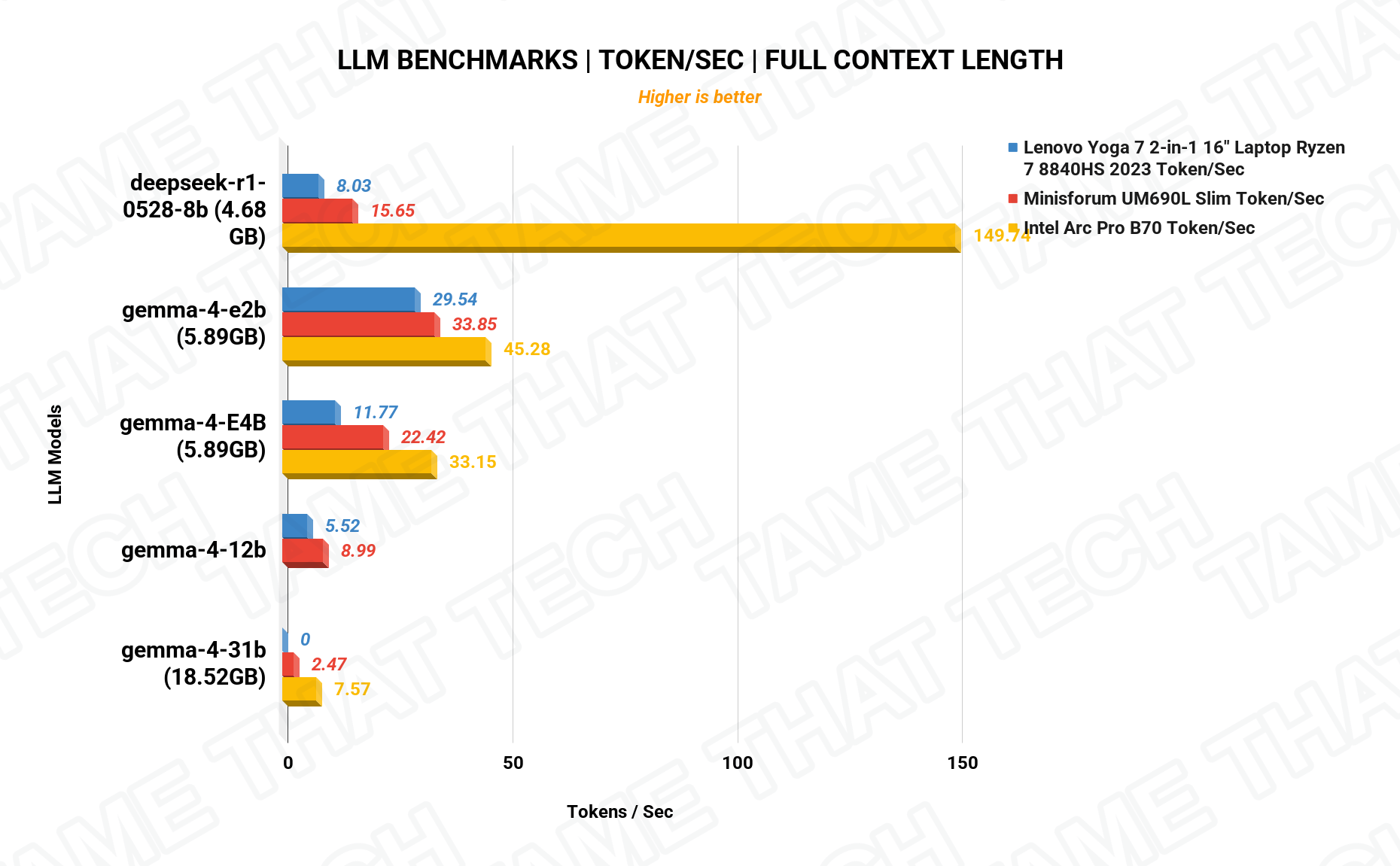
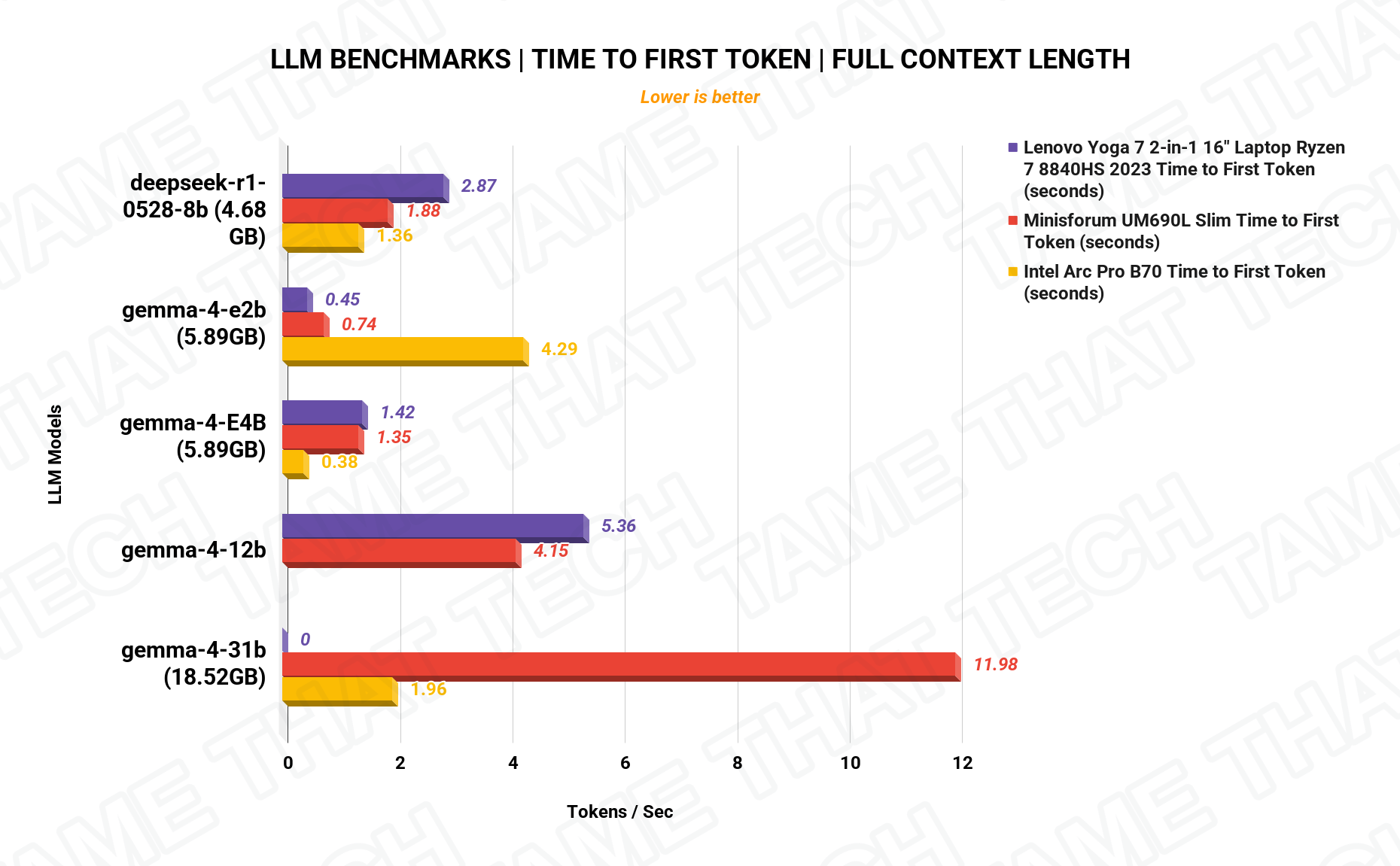
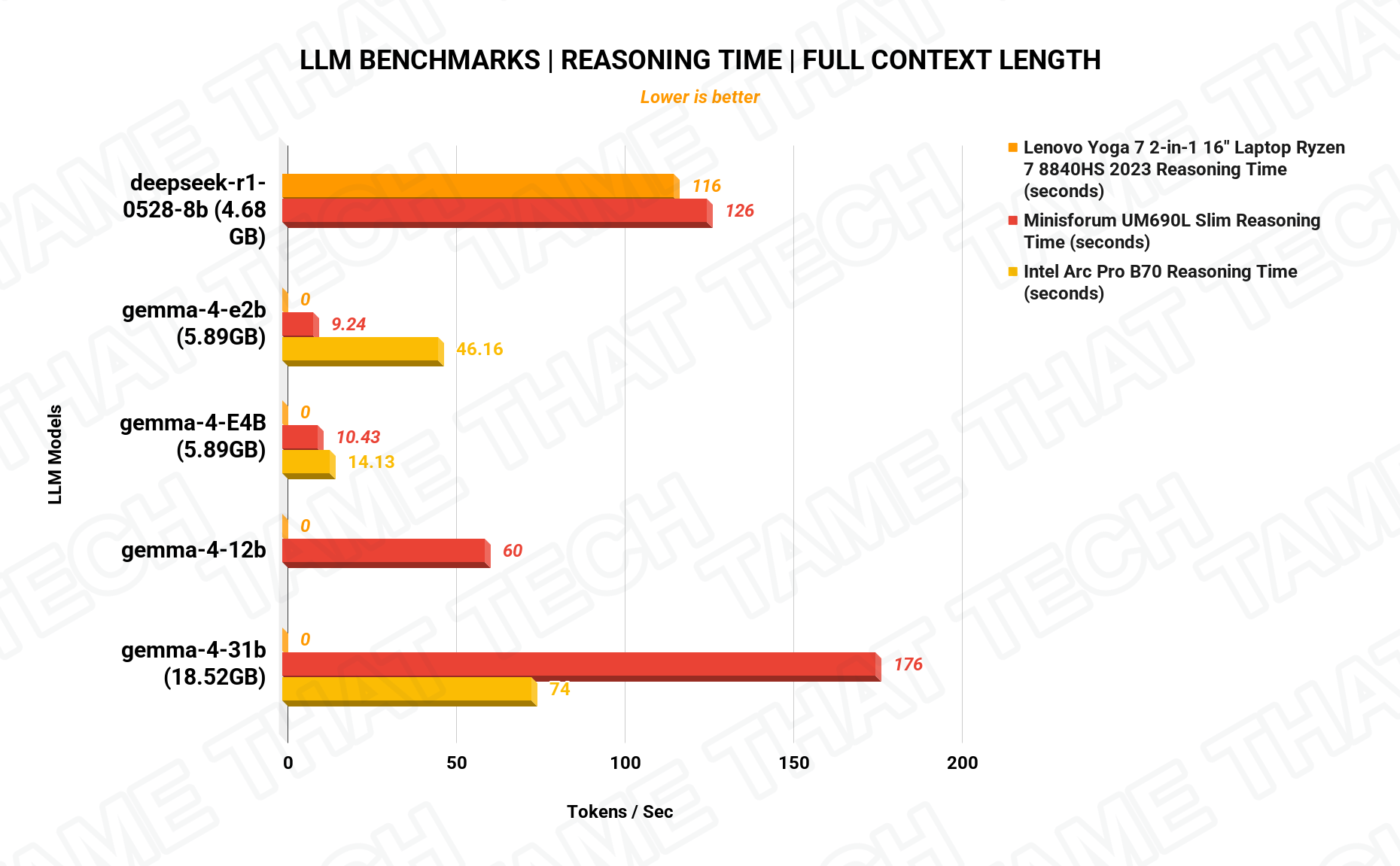
| Model | Tokens/sec | Time to first token |
|---|---|---|
| DeepSeek R1 8B (local) | 15.65 | 1.88 s |
| Gemma 4 31B (local) | 2.47 | — |
The DeepSeek R1 8B model achieved a fantastic 15.65 tokens/sec with a time-to-first-token of just 1.88 seconds. It even managed to run the heavy Gemma 4 31B model at 2.47 tokens/sec — most mini PCs with 16 GB of RAM would instantly crash, but the unified 32 GB pool keeps local models running smoothly.
Price & Availability
Pricing on the UM690L Slim varies by configuration and region, and Minisforum frequently runs coupons — check the current listings for the 32 GB / 1 TB config before you buy. It’s worth noting this is an older-generation (Ryzen 6000-series) platform, so it typically lands at a very competitive price for what it delivers.
- RAM is final: 32 GB is soldered — there is no upgrade path. Budget for what you need now.
- iGPU expectations: excellent for eSports and older/medium AAA titles, but next-gen engines will struggle.
- Great as a server: 6 W idle, 2.5 GbE, and dual M.2 slots make it a genuinely excellent homelab box.
Pros
- 8-core / 16-thread Ryzen 9 CPU with excellent multi-core performance
- Outstanding local AI support — runs 31B-class models on the unified 32 GB pool
- Extremely low power draw (6 W idle, ~88 W peak) and whisper-quiet operation
- 2.5 GbE + Wi-Fi 6E + USB-C with 100 W reverse power delivery
- VESA mount and HDMI cable included in the box
Cons
- LPDDR5 is fully soldered — no future capacity upgrades, ever
- Radeon 680M will struggle with cutting-edge next-gen game engines
- Single-core performance trails similarly equipped machines
The bottom line
The Minisforum UM690L Slim is a fantastic, versatile little PC. It delivers workstation-tier capabilities and localized machine learning without breaking a sweat. Whether you’re using it for work, media consumption, homelabbing, or casual gaming, this machine delivers — just be sure you can live with the 32 GB memory ceiling, because there’s no changing it later.
— Tame That Tech Minion
Discussion